

zazen
Member-
Content count
2,394 -
Joined
-
Last visited
Posts posted by zazen
-
-
Speaking of the Turkey-Istanbul deal and comparing it to today’s supposed deal in the making.
The reason this situation is referred to as a security dilemma is because a security guarantee requires a strong enough guarantor. But then that means two strong rivals who today have nukes could come head to head which is very high risk. It’s essentially tripwire Armageddon.
Having the guarantees be exclusively under a Western alliance is functionally NATO-lite. Your chained to whoever underwrites your security - so it being a bloc of Western powers means it can still be used as a pawn in a larger geopolitical game.
If the guarantees are multi-lateral or multi-polar - they dilute unilateral dominance and bloc logic. That way it also avoids Ukraine becoming anyone’s vassal and everyone has a stake in peace.
Post-WWII Austria followed that model. Austria was guaranteed by the US, USSR, Britain, and France. No one could absorb it without triggering the others, and it’s been neutral and stable till today.
A older but good Substack article from Glenn Dieseen going over this and the end game as the title of the thread says.
Post-WWII Austria proves this model works. Austria was guaranteed by the U.S., USSR, Britain, and France. No one could absorb it without triggering the others, and it’s been neutral and stable
A older but good Substack article from Glenn Diesen going over the Istanbul deal and the endgame of all this.
https://glenndiesen.substack.com/p/sabotage-of-the-istanbul-peace-agreement
Sabotage of the Istanbul Peace Agreement
The Making of a Proxy War & the Unavoidable Istanbul+ Endgame
“In February 2022, Russia invaded Ukraine to impose a settlement after some NATO countries had undermined the Minsk-2 peace agreement for 7 years. On the first day after the invasion, Zelensky confirmed that Moscow contacted him to discuss negotiations based on restoring Ukraine’s neutrality.[1] On the third day after the invasion, Russia and Ukraine agreed to start negotiations on a peace based on Russian military withdrawal in return for Ukrainian neutrality.[2] Zelensky responded favourably to this condition, and he even called for a “collective security agreement” to include Russia to mitigate the security competition that had sparked the war.[3]
The negotiations that followed are referred to as the Istanbul negotiations, in which Russia and Ukraine were close to an agreement before the US and the UK sabotaged it.
Washington Rejects Negotiations Without Preconditions
In Washington, there were great incentives to use the large proxy army it had built in Ukraine to weaken Russia as a strategic rival, rather than accepting a neutral Ukraine. On the first day after the Russian invasion, when Zelensky responded favourably to start negotiations without preconditions, the US spokesperson rejected peace talks without preconditions as Russia would first have to withdraw all its forces from Ukraine:
“Now we see Moscow suggesting that diplomacy take place at the barrel of a gun or as Moscow’s rockets, mortars, artillery target the Ukrainian people. This is not real diplomacy… If President Putin is serious about diplomacy, he knows what he can do. He should immediately stop the bombing campaign against civilians, order the withdrawal of his forces from Ukraine, and indicate very clearly, unambiguously to the world, that Moscow is prepared to de-escalate”.[4]
This was a demand for capitulation as the Russian military presence in Ukraine was Russia’s bargaining chip to achieve the objective of restoring Ukraine’s neutrality. Less than a month later, the same US spokesperson was asked if Washington would support Zelensky’s negotiations with Moscow, in which he replied negatively as the conflict was part of a larger struggle:
“This is a war that is in many ways bigger than Russia, it’s bigger than Ukraine…. The key point is that there are principles that are at stake here that have universal applicability everywhere, whether in Europe, whether in the Indo-Pacific, anywhere in between”.[5]
The US and UK Demand a Long War: Fighting Russia with Ukrainians
In late March 2022, Zelensky revealed in an interview with the Economist that “There are those in the West who don’t mind a long war because it would mean exhausting Russia, even if this means the demise of Ukraine and comes at the cost of Ukrainian lives”.[6]
The Israeli and Turkish mediators confirmed that Ukraine and Russia were both eager to make a compromise to end the war before the US and the UK intervened to prevent peace from breaking out.
Zelensky had contacted former Israeli Prime Minister Naftali Bennett to mediate the peace negotiations with Moscow. Bennett noted that Putin was willing to make “huge concessions” if Ukraine would restore its neutrality to end NATO expansion. Zelensky accepted this condition and “both sides very much wanted a ceasefire”. However, Bennett argued that the US and UK then intervened and “blocked” the peace agreement as they favoured a long war. With a powerful Ukrainian military at its disposal, the West rejected the Istanbul peace agreement and there was a “decision by the West to keep striking Putin” instead of pursuing peace.[7]
The Turkish negotiators reached the same conclusion: Russia and Ukraine agreed to resolve the conflict by restoring Ukraine’s neutrality, but NATO decided to fight Russia with Ukrainians as a proxy. Turkish Foreign Minister Mevlut Cavusoglu argued some NATO states wanted to extend the war to bleed Russia:
“After the talks in Istanbul, we did not think that the war would take this long.… But following the NATO foreign ministers’ meeting, I had the impression that there are those within the NATO member states that want the war to continue—let the war continue and Russia gets weaker. They don’t care much about the situation in Ukraine”.[8]
Numan Kurtulmus, the deputy chairman of Erdogan’s political party, confirmed that Zelensky was ready to sign the peace agreement before the US intervened:
“This war is not between Russia and Ukraine, it is a war between Russia and the West. By supporting Ukraine, the United States and some countries in Europe are beginning a process of prolonging this war. What we want is an end to this war. Someone is trying not to end the war. The U.S. sees the prolongation of the war as its interest”.[9]
Ukrainian Ambassador Oleksandr Chalyi, who participated in peace talks with Russia, confirms Putin “tried everything” to reach a peace agreement and they were able “to find a very real compromise”.[10] Davyd Arakhamia, a Ukrainian parliamentary representative and head of Zelensky’s political party, argued Russia’s key demand was Ukrainian neutrality: “They were ready to end the war if we, like Finland once did, would accept neutrality and pledge not to join NATO. In fact, that was the main point. All the rest are cosmetic and political ‘additions’”.[11] Oleksiy Arestovych, the former advisor of Zelensky, also confirmed that Russia was mainly preoccupied with restoring Ukraine’s neutrality.
The main obstacle to peace was thus overcome as Zelensky offered neutrality in the negotiations.[12] The tentative peace agreement was confirmed by Fiona Hill, a former official at the US National Security Council, and Angela Stent, a former National Intelligence Officer for Russia and Eurasia. Hill and Stent penned an article in Foreign Affairsin which they outlined the main terms of the agreement:
“Russian and Ukrainian negotiators appeared to have tentatively agreed on the outlines of a negotiated interim settlement: Russia would withdraw to its position on February 23, when it controlled part of the Donbas region and all of Crimea, and in exchange, Ukraine would promise not to seek NATO membership and instead receive security guarantees from a number of countries”.[13]
Boris Johnson Goes to Kiev
What happened to the Istanbul peace agreement? On 9 April 2022, British Prime Minister Boris Johnson went to Kiev in a rush to sabotage the agreement and cited the killings in Bucha as the excuse. Ukrainian media reported that Johnson came to Kiev with two messages:
“The first is that Putin is a war criminal, he should be pressured, not negotiated with. And the second is that even if Ukraine is ready to sign some agreements on guarantees with Putin, they [the UK and US] are not”.[14]
In June 2022, Johnson told the G7 and NATO that the solution to the war was “strategic endurance” and “now is not the time to settle and encourage the Ukrainians to settle for a bad peace”.[15] Johnson also published an op-ed in the Wall Street Journal arguing against any negotiations: “The war in Ukraine can end only with Vladimir Putin’s defeat”.[16] Before Boris Johnson’s trip to Kiev, Niall Ferguson had interviewed several American and British leaders, who confirmed that a decision had been made for “the conflict to be extended and thereby bleed Putin” as “the only end game now is the end of Putin regime”.[17]
Retired German General Harald Kujat, the former head of the German Bundeswehr and former chairman of the NATO Military Committee, confirmed that Johnson had sabotaged the peace negotiations. Kujat argued: “Ukraine had pledged to renounce NATO membership and not to allow any foreign troops or military installations to be stationed’, while “Russia had apparently agreed to withdraw its forces to the level of February 23”. However, “British Prime Minister Boris Johnson intervened in Kiev on the 9th of April and prevented a signing. His reasoning was that the West was not ready for an end to the war”.[18] According to Kujat, the West demanded a Russian capitulation: “Now the complete withdrawal is repeatedly demanded as a prerequisite for negotiations”.[19] General Kujat explained that this position was due to the US war plans against Russia:
“Perhaps one day the question will be asked who did not want to prevent this war… Their declared goal is to weaken Russia politically, economically and militarily to such a degree that they can then turn to their geopolitical rival, the only one capable of endangering their supremacy as a world power: China… No, this war is not about our freedom… Russia wants to prevent its geopolitical rival USA from gaining a strategic superiority that threatens Russia’s security”.[20]
What was Ukraine told by the US and the UK? Why did Zelensky make a deal given that he was aware some Western states wanted to use Ukraine to exhaust Russia in a long war - even if it would destroy Ukraine? Zelensky likely received an offer he could not refuse: If Zelensky would pursue peace with Russia, then he would not receive any support from the West and he would predictably face an uprising by the far-right / fascist groups that the US had armed and trained. In contrast, if Zelensky would choose war, then NATO would send all the weapons needed to defeat Russia, NATO would impose crippling sanctions on Russia, and NATO would pressure the international community to isolate Russia. Zelensky could thus achieve what both Napoleon and Hitler had failed to achieve – to defeat Russia.
The advisor to Zelensky, Oleksiy Arestovych, explained in 2019 that a major war with Russia was the price for joining NATO. Arestovych predicted that the threat of Ukraine’s accession to NATO would “provoke Russia to launch a large-scale military operation against Ukraine”, and Ukraine could join NATO after defeating Russia. Victory over Russia was assumed to be a certainty as Ukraine would merely be the spearhead of a wider NATO proxy war: “In this conflict, we will be very actively supported by the West—with weapons, equipment, assistance, new sanctions against Russia and the quite possible introduction of a NATO contingent, a no-fly zone etc. We won’t lose, and that’s good”.[21]
NATO turned on the propaganda machine to convince its public that a war against Russia was the only path to peace: The Russian invasion was “unprovoked”; Moscow’s objective was to conquer all of Ukraine to restore the Soviet Union; Russia’s withdrawal from Kiev was not a sign of good-will to be reciprocated but a sign of weakness; it was impossible to negotiate with Putin; and NATO Secretary General Jens Stoltenberg subsequently asserted that “weapons are the way to peace”. The Western public, indoctrinated with anti-Russian propaganda over decades, believed that NATO was merely a passive third-party seeking to protect Ukraine from the most recent reincarnation of Hitler. Zelensky was assigned the role as new Churchill – bravely fighting to the last Ukrainian rather than accepting a bad peace.
The Inevitable Istanbul+ Agreement to End the War
The war did not go as expected. Russia built a powerful army and defeated the NATO-built Ukrainian army; sanctions were overcome by reorienting the economy to the East; and instead of being isolated – Russia took a leading role in constructing a multipolar world order.
How can the war be brought to an end? The suggestions of a land-for-NATO membership agreement ignores that Russia’s leading objective is not territory but ending NATO expansion as it is deemed to be an existential threat. NATO expansion is the source of the conflict and territorial dispute is the consequence, thus Ukrainian territorial concessions in return for NATO membership is a non-starter.
The foundation for any peace agreement must be the Istanbul+ formula: An agreement to restore Ukraine’s neutrality, plus territorial concessions as a consequence of almost 3 years of war. Threatening to expand NATO after the end of the war will merely incentivise Russia to annex the strategic territory from Kharkov to Odessa, and to ensure that only a dysfunctional Ukrainian rump state will remain that is not capable of being used against Russia.
This is a cruel fate for the Ukrainian nation and the millions of Ukrainians who have suffered so greatly. It was also a predictable outcome, as Zelensky cautioned in March 2022: “There are those in the West who don't mind a long war because it would mean exhausting Russia, even if this means the demise of Ukraine and comes at the cost of Ukrainian lives”.[22]
From that time:

-
8 hours ago, BlueOak said:Point me at the gain here for Russia Zazen
How are they better off now than they were 10 years ago?Like I said to Purpletree in the other thread - Imperial logic is primarily for gain whilst security logic is primarily for preservation. The calculus here wasn’t gain but preservation in a zero sum security environment created by the Wests refusal to develop a security architecture that acknowledged red lines and didn't expand NATO towards Russia - up to the last vital country which for them is Ukraine specifically.
You say Russia could have bridged East and West - but that assumes the West ever intended to let Russia be a co-equal. Putin did try alignment in the early 2000s like talk of joining NATO. Turkey works as a bridge because it isn't as threatening, whilst Russia’s scale is threatening. Its too big to be ignored yet too big to be allowed fully into the club - unless it sub-ordinates its sovereignty. Russia is big enough to be it's own orbit and not be totally compliant.
Didn't Russia try diplomatically reaching out to the West regarding developing a security architecture? Many Western heads themselves warned of NATO expansion, Putin himself made it clear especially in his 2007 Munich speech. Before the invasion even began Russia proposed draft treaty that was ignored. The initial push to Kiev was to force a concession and bring them to the table - but because Kiev resisted upon the backing of the West - Russia went to the next option: if they don’t take your concerns seriously you make them not much of a concern through a war of attrition.
Bidens term was radio silent on diplomacy, same with Europe despite the war being on their conflict and them feeling the brunt of the consequence in high energy prices. The Istanbul talks were the closest to a deal that was torped'ed by UK's Boris and the US. A deal they'd probably accept in a heartbeat compared to any today (which I doubt they'll even get to). The EU leaders are praising Trump for opening diplomatic channels to Putin as if they couldn't just do so had they had the spine and not been mired in group think like some ''Putin is Hitler'' cult. Ironically Putin isn't even as hardline as Medveded or others.
8 hours ago, BlueOak said:Instead, they wanted a buffer zone more than to accept some liberalism, because change was too difficult. The EU and the USA have adjusted to a more authoritarian stance for about 20 years, but Russia didn't move an inch to align over the last decades, Whereas China did a lot of work.
The issue is liberal universalism can't accept different poles and buffer zones. How has China become more politically aligned to the West? They've economically aligned and developed just like Russia had. Russia has been supplying almost half of EU's energy, it was integrated economically just like China - they traded what they had ( Russia energy, China manufactured goods ).
I agree that China has done a way better job than Russia in using that wealth to develop itself - Russia's own corruption has fueled oligarchic profits at the expense of the nation for sure. But that's different to the geopolitics of whats occurring. Whether it's a democracy, communist, socialist or whatever - a rival power is encircling another power, approaching a country with a historically vulnerable corridor - any powerful country will react to this. Just like America is a liberal democracy yet it forced a neutralization of the Cuban missile crisis. The internal shortcomings or political systems of a country is a separate issue to the geopolitics between states and powers.
Every country and culture has its own way of doing things - the issue with the West is they morally finger wag a country for not being a copy cat of themselves - despite dealing with countries completely opposite to them (Saudi for example). This is why BRICS is appealing - there's no BRICSm like liberalism that is being shoved down countries throats - just pragmatic partnering on all kinds of projects that retains a level of sovereignty that being part of the Western club doesn't allow for.
-
23 minutes ago, PurpleTree said:It‘s too long ago to really compare imo. 1962 it was a different world.
The principle is timeless in what it revels: a great power reacts forcefully to a rival power placing a military installation or foothold near its core security perimeter.
It doesn’t matter if its 1962 or 2062. The logic of security dilemmas, red lines, and existential threat perception hasn’t changed and will never change unless some paradigm breaking shift in technology or consciousness happens.
First you gloss over the nuance of what I’m saying, then you dodge dealing with a hypothetical, then the real example is “outdated”. You’re conveniently avoiding where the questions are leading to broski.
-
1 hour ago, PurpleTree said:I think you’re either from Pakistan or Muslim from India 👍
Not a fan of hypotheticals.
What about the Cuban missile crisis which isn’t a hypothetical.
The US acted with force and coercion undermining Cuba’s sovereignty - but its actions weren’t imperial because the intent was preservation of the countries security, not accumulation or domination. This occurred despite them still being a imperial nation, but in this specific context their action was clearly done out of security logic.
Had it been Mexico and not Cuba it would have been even more threatening as Mexico and the US share a lengthy border with flat terrain = easy for troops and tanks to roll through and conquer the US from. Just like Ukraine and Russia today. It would be totally understandable yet simultaneously condemnable for the violence and suffering.
1 hour ago, PurpleTree said:I think 🤔 but never really thought about it. Yea the Spanish government was quite harsh. Uncalled for imo.
But for a dictatorship it needs other stuff too. Like no freedom of speech, no freedom to criticise the government, press freedom etc.True, you do need other things. In the same way, you need other things to make something imperial or not - such as intent and context.
On the surface - violence, territory capture and civilian death can all occur - but those behaviours alone don’t make a war imperial, just like how the crack down alone doesn’t make Spain dictatorial.
Those things can happen under tragic, defensive or reactive circumstances. Like in WW2 against Hitler. There was mass violence. But the allies weren’t trying to gain something (imperial), but more so preserve something (defend) against an imperial expansionist force (Hitler’s Nazi Germany).
To name a non-Western example of imperialism for example: what the UAE is doing in Sudan (backing RSF) is imperial as it has no defensive context in which it can exist.
-
@PurpleTree You can’t decide whether I’m a Chinese, Russian or Indian agent 😂 no rupees, yuan or rubles here.
So what about that hypothetical for Ibiza and Spain - would it be an imperial move for Spain to force Ibiza’s neutrality if they wanted Chinese or Russian missiles and there was a historic beef between China / Russia and Spain? Or perhaps in Andorra wedged between France and Spain. Would France or Spain be imperial for stopping this by force?
Does Spain cracking down on Catalonians make it a dictatorship because its surface actions mimic that of a dictatorship? You know, it looks like that so must just be that.
Guardian: “Speaking to the Guardian at the end of a turbulent week that has seen 14 senior Catalan officials arrested, almost 10m ballot papers seized and thousands more police ordered to the region, Carles Puigdemont said he feared Spain was returning to the repressive practices of the Franco era.”

-
@BlueOak Russia has paid a cost - but not acting also has a cost that could end up terminal in the end. It’s possible to pay a price today to avoid a heavier one later.
Why would they risk possible global backlash for invading, economic damage and sanctions, a million dead, and internal political instability over a country they control 100% by proxy as you commented in another thread tagged below.
Russia invaded precisely because it was losing control over Ukraine, not because it had control. Ukraine's pivot toward NATO membership, its rejection of Russian security demands, its military buildup with Western weapons - are all signs of Russia losing influence, not exercising it.
On 16/08/2025 at 8:22 AM, BlueOak said:To conclude
Russia spent a million casualties on retaking 20% of a country they've controlled 100% via proxy, with ruined settlements and barely any population living there. They've tanked their economy. They've gained stronger BRICS allies, some minerals, some important ports. They've lost much of their youth to death, disability or leaving the country to set up lives elsewhere. Their demographics are worse than ever, much of their economy is chinese and they are more a proxy of China due to reliance on Trade, Chinese investment in Russia and the sheer power of China relative to Russia when not balanced out by European influence or allies.
The same issues you say plague Russia, plagues the West and more so Europe. Economic fragility, aging demographics etc. Countries that fight wars they see as existential don’t mind for a few hits in GDP.
The UK right now has a multi billion pound black hole it’s trying to fill with possible tax hikes and further austerity in the autumn budget. Our capital has tents in the most prestigious areas and meat in Tesco grocery store literally security boxed due to theft.
They’ve just put a “mind the grab” strip on the pavement of Oxford street due to theft high phone theft that happens. NHS.. don’t get me started.
-
41 minutes ago, PurpleTree said:That’s very nice. And very convenient. It just looks like it. But it isn’t it. 🤯 mind blown
You completely gloss over the nuance man. Must be the purple you smokin. Like I said above:
1 hour ago, zazen said:- Imperial logic seeks domination and accumulation - to get or maintain power, profits and primacy by force.
- Defensive logic seeks protection and preservation - to maintain territorial integrity via strategic depth or buffer zones from a rival power - and yes, they use aggression and force also.
For example, during the Cuban Missile Crisis - did the US act imperially? On the surface sure. But was the motive imperial in that very situation? No. I can agree that it was done out of security logic even though the US was a imperial power at the time. That scenario it acted within was not for gain but preservation. I can totally understand it from a security lens - and comprehend any state acting in such a way if put in the same position.
If it feels wet is must be water, it can't possibly be sparkling or coke?
Spain cracked down on Catalonian separatists, jailed democratically elected officials, stomped on referendums with a jackboot, and silenced political expression. Looks like a dictatorship, so it must be? But we all know it’s not. Because form isn’t function.
Imagine if the Chinese just started getting really into House music and fell in love with the mecca of house music - Ibiza. Ibizan's had their own distinct identity to mainland Spain and wanted to to be independent - the Chinese, wanting to protect their new found love for the island started talking of aiding them in this separation and even sporting Chinese missiles and defense infrastructure. Would Spain cracking down on this with force and violence be imperial?
Remember the distinction above - imperialism is for gain not preservation of a state. But you'll see Spains use of violence and force and conclude imperial.
-
3 hours ago, PurpleTree said:Dude isn’t Russia « doing » neo imperialism?
Isn’t it funny that Russian gollums and you paint the Europeans as "Eurocons" warhungry, hawkish etc.
while Russia is literally attacking an other country, killing civilians, destroying it, grabbing land?
Yeah, their *doing* imperialism in form but not in function. Russia is "doing" things that look imperial - violence, territory capture, civilian death. But "doing imperial-looking things" isn't the same as "being imperial" if the driving logic is defensive rather than domination based. That's a surface level application of the word. Like saying ''all liquid is wet'', but is it coconut water or acid? It's like saying ''all violence and suffering is bad'' - just stating the obvious trying to sound morally goody goody but providing no nuance that could help solve the root cause of that suffering and violence.
Everyone knows violence is bad. The question is: why did it happen, how do you prevent more of it, and what are the underlying dynamics that created the conditions for it? In this case - a uni-polar hegemon not accepting the red lines of another power or sphere existing in a multi-polar reality. That's why you can still get people on this forum asking why we should care about Russia's red line or sphere, or that we should push back against their sphere - which is what caused the issue to begin with.
- Imperial logic seeks domination and accumulation - to get or maintain power, profits and primacy by force.
- Defensive logic seeks protection and preservation - to maintain territorial integrity via strategic depth or buffer zones from a rival power - and yes, they use aggression and force also.
For example, during the Cuban Missile Crisis - did the US act imperially? On the surface sure. But was the motive imperial in that very situation? No. I can agree that it was done out of security logic even though the US was a imperial power at the time. That scenario it acted within was not for gain but preservation. I can totally understand it from a security lens - and comprehend any state acting in such a way if put in the same position.
There has to be an actual defensive logic, where a country's existential safety is put at risk. When it acts upon that risk, it might display the surface level behaviour of an imperial power (violence, force, coercion etc) but it can be understood not to be imperial in intent and instead be comprehended through the strategic lens of security.
That's why a super majority of the world detest Israel and it's actions, whilst simultaneously a much of the world seem to understand (not necessarily condone) Russia's actions. Majority of the world (Global South) who've experienced colonialism and imperialism can identify the difference between imperial expansion and a security response to encirclement and encroachment, even if both involve violence. Another question is: who's been coming to who's borders? Which direction of travel has been tippy toeing to who?
-
Who is saying Russia bombing civilians is okay on this forum? I think your conflating understanding a war (and what caused it) to condoning it. I've never seen Raze justify any such thing or root for Russia. I am rooting against anti-imperialism, not necessarily the aggressive methods used by those resisting it. The same way people can root for the Palestinian cause, not necessarily the methods (October 7th) used in the name of that cause.
The moral consistency is in opposing imperialism and all suffering. The inconsistency is in misdiagnosing what is and isn't imperial, and what is the cause of that suffering. The inconsistency is in not understanding the distinction between security logic (state security) and domination logic (imperialism)
There are parallel similarities on the surface - such as both involve violence, civilian death and land grabbing. But their are different contexts and motives behind each - security vs domination. It's not double standards as much as it is the same standards being applied to different contexts.
A stateless people don't threaten the security of a advanced nuclear state backed by a world super power. Meanwhile, a global nuclear super power that's been naughty for many decades and who you have a cold war history with does threaten your security if it were to be on your doorstep in a historically vulnerable corridor.
People can understand the threat perception Russia has - it's comprehensible within a geopolitical security logic. But not the one Israel has - Israel has to magnify it into something its not to justify their behaviour under the banner of security - when it's domination dressed up as security.
Russia / Ukraine is a interstate war, Israel / Palestine is a occupying force subjugating any resistance and uprising to that occupation. Russia can live with a state of Ukraine that remains neutral, Israel is denying a Palestinian state existence entirely. Ukrainian civilian death is a tragic byproduct of war, Palestinian civilian death is a horrific result of occupation that is based upon domination. Both horrible.
Israeli "security" can only be achieved through Palestinian elimination. Russian security can be achieved through Ukrainian neutrality.
Russia says: You can be sovereign but within the limitation that you don't use that sovereignty to threaten our existence. Be like Finland (neutral).
Israel says: You can't be sovereign at all. Cleanse yourselves and any remaining Palestinians should exists like Native Americans on reservations.
On 8/10/2025 at 6:14 PM, zazen said:@BlueOak The difference is that Russia see’s a superpowers imperial reach coming through a neighbour as a threat, while Israel sees the neighbour themselves (who is stateless and powerless) as a threat.
A proper threat assessment has to be made to distinguish between an existential threat, a national security threat, or a threat to empire and imperial domination. Otherwise situations are misdiagnosed and what is defensive is framed as domination or vice versa.
You can have a legitimate security concern, gone about in an illegitimate (yet understandable) way. Or an illegitimate or inflated security concern, gone about in an illegitimate way ie Israel or a unipolar hegemon maintaining its primacy in a multipolar reality.
Israel frames what is a national security concern (October 7th - non state actors) as an existential concern. In fact the far right frame Palestinian existence itself as an existential threat - recoiling at even the mention of the word Palestine.
The US frames a threat to their uni-polar hegemony as a national security threat. A illegitimate concern (maintaining global primacy in a multi-polar world ) + inflated concern (treating developments in far off continents as existential), handled in illegitimate ways (wars of choice, regime change, sanctions etc).
Understanding why a state feels threatened isn’t excusing what they do about it or how they go about it - in bad ways. But the main reason to distinguish it is because security concerns can usually be dealt with diplomatically whereas a power looking to dominate can’t be reasoned with.
Every territorial expansion or war isn’t imperial driven and based on domination - they can be security driven. The gains in territory are incidental and secondary not primary. It’s like saying all water is wet - on the surface it’s true but it oversimplifies and misses important distinctions.
Most of the cases you listed start with a proximity based security logic ie their not acting for dominations sake - that doesn’t justify their methods or make them clean. A unipolar hegemon skips proximity logic and treats developments in places thousands of miles away as existential threats.
Even their abuses of power are above law. The US literally has a law that allows it to be lawless - The Hague Act legalises them storming The Hague if one of their own are in the hot seat. But legal doesn’t always mean legitimate. Just now they’ve put a $50mill bounty on another head of states - Maduro of Venezuela. This is empire logic not security.
I put my those examples into Chat GPT with those distinctions:
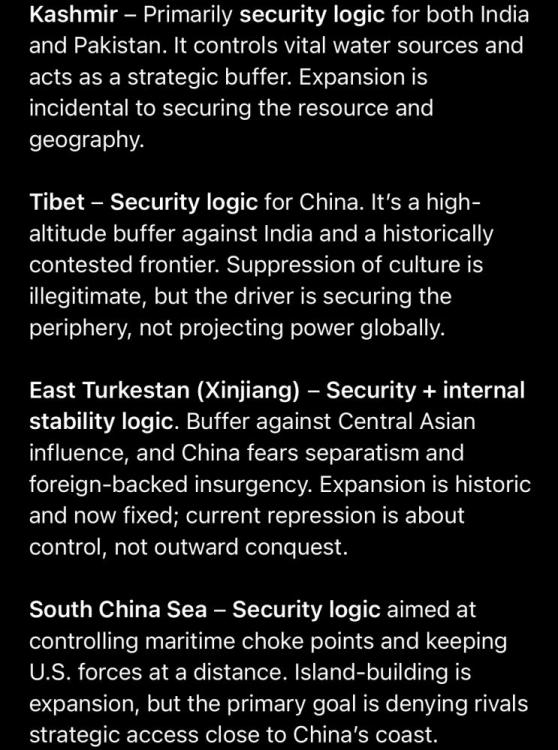
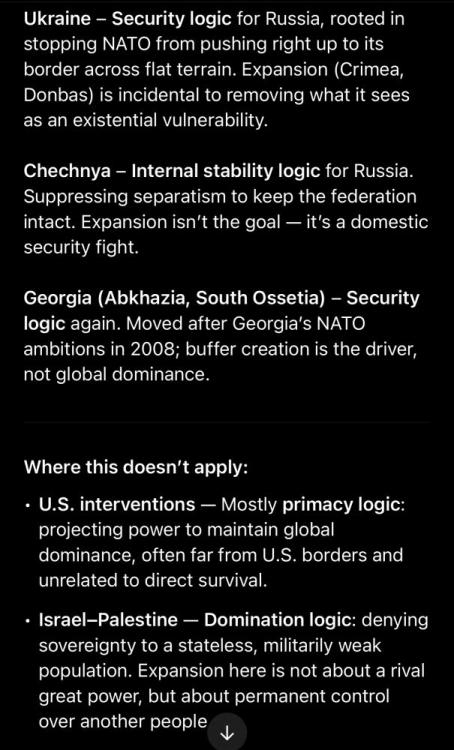
Here you asked about how isn't Russia behaving imperially against Chechnya.
On 8/10/2025 at 11:20 PM, zazen said:Palestinians are trying to succeed at the self-determination of a state, not seceding from an already existing one. So it’s not about territorial integrity of an already existing state but denying a group the sovereignty of having one their already entitled to.
Balochistan is similar to Chechyna - already part of an existing state (Pakistan) but with a separatist movement. They’re dealt with aggressively which is authoritarian but not imperial. Different states deal with separatists differently, some more aggressive than others - but generally no state just willingly gives up territory as it can set off a domino affect for others to separate.
We were talking on another thread about Uyghurs and I responded regarding their treatment and how states act to preserve themselves.
Spain for example cracked down on Catalonian officials leading the separatist referendum. That can’t be classified as imperialism just because it’s aggressive or authoritarian - there are distinct differences. A country can be authoritarian without being imperial - North Korea for example.
Many people misdiagnose security logic and motive for imperialism and domination - which implies there’s no legitimate concerns to be solved diplomatically, thus the only solution is to deal with the “evil Hitler” militarily.
A unipolar hegemon like the US is blind to other nations security concerns because they believe they are the exception (American exceptionalism). They’re also the exception from international law and war crime persecution from the ICJ (Hague invasion act). They believe the entire globe is their sphere of influence but another powerful nation having one is imperialism.
Its the same underlying mentality Israel has towards Palestinians - arrogance and exceptionalism fuelling domination. It’s this same mentality that flips other countries reactions to imperialism and calls it imperialism itself. That’s how we get US officials calling the South China Sea a national security threat .. all the way in Chyna 😂 Ok boomer.
-
12 minutes ago, Lyubov said:Seems to me a Europeanized and democratic Ukraine in NATO is such a threat because it threatens the totalitarian “Tsarist” form of government. People forget at one point in time Russia was going in this direction too but authoritarianism squashed it out every time. Who is this war protecting exactly? Russia after al lente in and inflicted violence and death on their own soldiers in doing so. I’m not sure I buy Ukraine being a security threat to Russia, it’s a security threat to the tsar, not Russia itself nor democratic states which Russia claims to be and has no problem borrowing the facade of.
Don't you think your diagnosing something as political when its geopolitical? A country’s form of government doesn’t override its strategic interest and national security.
Whether democratic or authoritarian, powerful nations respond to existential threats the same way: by drawing red lines and enforcing them.
A democratic United States was ready to risk nuclear war during the Cuban Missile Crisis. Preserving strategic space is dictated by position (geopolitics), not principle (politics, internal or external). Are you saying that if say Russia and Ukraine were both free and democratic - but Ukraine was still integrating a rival superpowers military umbrella - Russia wouldn't react simply because Ukraine and Russia are both politically the same?
A rival power was installing strike capabilities within the US immediate sphere, the same is being flirted with today in Ukraine. Ukraine alone isn't a threat - a rival alliance led by a superpower platforming itself in Ukraine is - the same actors who want to maintain global primacy and have think tank papers citing how they want to overextend and contain you.
-
When nuclear powers are involved, these noble principles about sovereignty and agency become secondary to the primary imperative which is: don’t blow up the planet.
It’s better to be 80% sovereign and alive, than 100% sovereign and dead.
International laws written in ink don’t somehow erase survival and power dynamics that can end up being settled in blood.
Laws and rights are our noble attempt to buffer against might and the laws of the jungle - but they don’t erase or deny that the jungle exists. Likewise, marriage contracts don’t eliminate sexual desire for others.
Paper doesn’t negate the primal instincts it seeks to contain. We nurture (through principle) nature (power dynamics) to the best of our ability.
Russia didn’t invade Ukraine because they suddenly forgot international law exists. They did it because they calculated that NATO expansion posed a greater existential threat than laws telling them their in wrong for breaking those laws.
Jungle logic overrides legal logic when survival is at stake - so best avoid putting it at stake. You don’t bring about security by making another power insecure in crossing their red lines - but by acknowledging them.
What should the US do if Russia or China were to build military infrastructure in Mexico? Or UK if Russia or China were to do the same in Scotland? The Cuban missile crisis happened did it not?
-
1 hour ago, Scholar said:By the way for those who say "Russia didn't want a NATO country bordering them, they need a buffer zone!".
There already are NATO countries bordering Russia, there have been for a long time, and they are much closer to the Moscovites than Ukraine.
Context matters. Powers have red lines, some red lines are more critical than others. Geographic borders aren’‘t just some pretty lines on a map. There are life and death calculations that determine whether one border is strategically more vulnerable than another.
Finland is heavily forested terrain. The Baltics are also not ideal terrain to march through in an offensive, only have a population of 6 million, and narrow borders.
Ukraine is a massive country with vast flat terrain to create the infrastructure of a forward base from, to stage offensives from and move masses of troops and tanks through. It’s been a historic invasion corridor (Napoleon, Hitler), has a population of 40 million, and a lengthy border almost 7 times that of Estonia.
Estonia being part of a NATO is a strategic mosquito bite, Ukraine doing so is strategic kneecapping.
-
15 hours ago, PurpleTree said:Thanks for living in the West and paying your taxes here though so that we can keep this thing running. ❤️
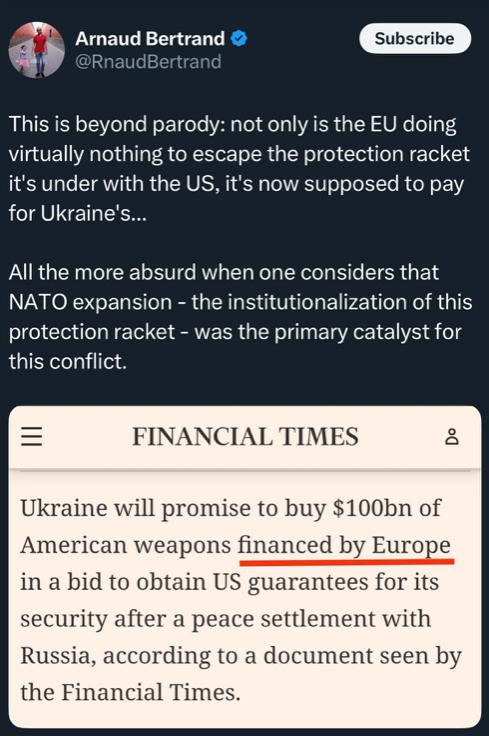
You too papi. Looks like we gonna chop up some more though:
-
6 hours ago, Scholar said:Russia might want a buffer state, but why would anyone in their right mind care about that?
Russia has no entitlement to having buffer states. They are a failed empire, they are corrupt and attempt to corrupt the bufferstates we are speaking of because they threaten their political system. Therefore, the surrounding states have every right to protect themselves from Russian influence and embrace western influence. Russian oligarchs might hate that, but we aren't going to allow an authoritarian state to maintain it's "sphere of influence" just because they threaten war if we don't respect their evil wishes.
If they want conflict, then we will give it to them. We contain them until they are a failed state, for the prosperity of every country that would have to be a "buffer" state to make the corrupt oligarchs in Russia feel safe.
This is what real geopolitics looks like. The West has every reason to put Russia back into the stone age, and that's exactly what they should do and hopefully will do. Too bad if you can't accept real geopolitics because you have some sort of twisted moral worldview where the victim of an abuser has to remain in the relationship with their abuser because the abuser feels threatened by the idea of her finding a new boyfriend.
What does that even mean a "mature way to exist", you can't let a corrupt system just proliferate itself because "multipolar world tho!". The mature thing to do is to end Russian influence, which we have the opportunity to do. We destroy them militarily, economically and politically, and the nations surrounding Russia can develop and progress rather than being held back perpetually by a corrupt oligarchy.
Hawkish much? We’ve evolved from neocons to Eurocons.
The US and the West aren’t entitled to be everywhere and anywhere on this planet. Many places on the planet are still corrupt - by your moral crusader logic the West should go develop those regions in Africa, Latin America and Asia too. Sounds like colonialism, but maybe not if it’s consensual. Let’s go liberate Pakistan as it’s been notoriously called a failed state (multiplied IMF bailouts) full of corruption too.
That isn’t what real geopolitics is - that’s the law of the jungle which you ironically advocate for whilst moralising as if you don’t. You’re basically making a case for imperialism without realising it. Putting countries back into the Stone Age is a Stone Age mindset unfit for the modern world - your developed and actualised though rite?
You start by asking why should you care about buffer states? Then finish your comment asking what is a mature way to exist (in a multipolar world) lol. Your entire emotional temper tantrum is full of holes I could fill a book with.
The West has been invested in Ukraine for decades and corruption still remains. This isn’t magically the cause of Russia being its neighbour. Zelensky just attempted undermining anti-corruption agencies, prompting large wartime protests. He only U-turned after public and Western backlash. Imagine Western funds from taxpayers being sent if he hadn’t - the already cratering credibility of Western politicians would be shotgunned.
Your entire worldview assumes the West as the naturally benevolent unipolar hegemon that’s entitled to the entire global sphere as its sphere of influence and imperialism - whilst denying the legitimate security concerns or existence of any other sphere possibly existing.
Western unipolar global dominance is an aberration in history - mere blip on the timeline. Go fix your historical amnesia and ignorance - because this aberration is now ending, and the Western arrogance, entitlement and supremacist attitude will be adjusted along with it.
-
12 hours ago, BlueOak said:@zazen
1) Why not just deal with Russia?
This is dealing with Russia. Its a perfect understandable mirror over cultures and populations that share a long conflicting history, many similar cultural values (in the immediate region), but conflicting ideologies, in a new multipolar dynamic with competing interests. It's like asking why don't Russia just deal with these many countries to its west? Well they are.
@PurpleTreeOn Nukes, yes. I've called for that for years. That's why Putin did it in Belarus. It'll help deter invasion of Belarus in the coming decades. Its exactly what needs to happen to secure that zone of conflict for a few decades.
1A) An addition: Europe still funds Russia. No. You keep posting this in different threads @zazen, so I'll post it here again. The scale has flipped
As I've just sourced this with Chat GPT, i'll just copy paste GPT conclusions:Quote:
- Oil: The EU cut Russian crude and products from ~29% of its oil imports in 2021 to ~2% in early-2025. That’s orders-of-magnitude smaller revenue than pre-war.
- Gas: Russia’s share of EU gas fell from ~45% pre-war to ~15–19% in 2024/25 (mix of pipeline + LNG). Norway and U.S. LNG have largely displaced it.
- Total trade: EU goods imports from Russia dropped ~78–86% vs early-2022, even if some flows (nickel, LNG) remain. The direction of travel is clear. Reuters
Yes, India and China absorbed much of the oil, at a discount. That’s why Moscow leaned on a shadow fleet and non-Western insurance. Discounts widened again this month, underscoring Russia’s weaker pricing power.
End Quote
2) You can’t sanction half the world (BRICS). Power is in chokepoints, not headcounts.Population is not leveraged. The G7 and EU still dominate finance, shipping insurance, advanced tech, and capital markets. There are focused sanctions targeted at these points, which is easier given the dominance. Chat GPT adds: Even with BRICS expansion, nominal-GDP weight still trails the G7 and is fragmented by divergent interests. (PPP shares look larger but don’t buy chips, tooling, or underwriting.) I generally liked its take more than mine here, as it brings up some interesting points.
3) Russia’s war economy is fine. Really?
Another stat quote here for speed:
Russia’s defense burden is now 6–7% of GDP; the 2025 deficit was raised to 1.7% of GDP, and the central bank hiked to 21% before easing to 18%—classic overheating control. This isn’t collapse, but it’s expensive and crowding-out.
To me this is the biggest point of propaganda. In real terms nobody's economy is doing fine. Least of all a country which is printing 15-19% of its money every few months, is propped up by BRICS members buying energy they don't need at a discounted price, and has its refineries (its major export) hit daily. Its country is tooled up to a wartime economy, and it spent 1 million lives, many of which will be carried as a burden one way or the other by the state, both physically and psychologically. Plus how many millions that have fled and won't return, because they have families/lives/good jobs elsewhere now.4) Manpower doesn't decide a war. Quantity helps, but quality, gear, and politics ultimately decide outcomes
UK MOD and the CSIS list Russian casualties KIA and WIA past 1 million this summer. That's an enormous casualty strain and bill for the country to carry. Maintaining their push requires hard cash, and prison recruiting both of which are dried up. These are signs of strain not a healthy military.
The kill ratio exceeds the population imbalance you describe. Which is why, almost four years on, this is a very slow front.
5) Ukrainians just want a deal. Yes. To a ceasefire, not to capitulation
Quote for speed:
Gallup finds ~69% want a negotiated end “as soon as possible.” But Ukrainian polls also show little willingness to concede territory and strong belief Russia would violate a paper peace. That’s not hawkish elites forcing war; it’s a public that wants peace with security, not a reset to the next invasion.6) Georgia and Azerbaijan in NATO is just antagonizing Russia?
Two things here to start: Azerbaijan has never been a realistic NATO candidate in the past; While Georgia has sought a path for years.
Something you struggle with in your analysis are points like this, great power red lines don't erase neighbors agency. The Helsinki Final Act norms are states choose their alignments. Realism matters, but so do rules to govern a multipolar world, or smaller states live at the mercy of spheres of influence, and we end up in eternal conflicts. Leo would tell me they do live at their mercy, then i'd reflect that's the source of eternal conflict, until those states or populations are considered they'll just be pawns to fight or compete over. - Infact that's a realisation i've just had, not doing so is why sphere's of influence live in competition.
7) Europe is pacifist bureaucracy; 5% of GDP talk is fantasy?
Again GPT does stats far better than me:
The EU was slow, but the trend is up: NATO just signaled a new spending envelope (3.5% core + 1.5% broader security); Poland is pushing ~4.7–5%; the UK is moving toward 2.5% (with some leaders floating higher over the 2030s). Industrial capacity (ammo/drones/air defense) is expanding from a low base. It’s not instantaneous, but it is material.8) China will replace Europe for Russian gas?
The Power of Siberia-2 still lacks a finalised contract and price; Beijing has kept Moscow waiting to extract terms. Even if built, 50 bcm doesn’t replace pre-war European pipeline volumes. I am trusting the GPT's conclusion on this i'll place sources in the next post.
I’ll be brief. Man it’s like a homework assignment haha
1. That’s not dealing with Russia diplomatically but throwing down with Russia instead.
1a. I know Europe and US have massively drawn down their trade with Russia. In another thread I simply pointed to the fact that India and EU trade in almost the same amount in dollar terms yet India is being punished for it.
2. It’s because they are choke points that are being weaponised - that bypasses are being built around them. BRICS are trading in their own currencies.
3. It’s managing an overheated situation economically which is true, but this is far from impending collapse. The reason they can even hike rates to 20% is because they aren’t as indebted as the Western financial system. The Ruble hasn’t crashed as expected from all this but has been the best performing currency this year. It’s a situational stress (during war time) not systemic. Expansion of the money supply to fund the war occurred with the US in WW2 (44% of GDP) and yet they remained resilient and came out on top after.
Russia spending 6-7% GDP is a burden but yet Europe spending 5% isn’t? When they have way higher debt to GDP (countries with over 100%) and welfare obligations their populations are expecting - that Russians aren’t because they have a different baseline and social contract with their government that doesn’t safety net them cradle to grave? France erupts into protest when the retirement age increases by 2 years from 62 to 64.
The point is Europe isn’t ready for a long war when it’s not even ready to delay retirement by two years. I’ve never said Russia is booming and ascending with BRICS to rule the world - I’ve said both are suffering but who in this war of attrition can suffer longer.
4. Tied to point 3 - expensive quality gear and arms costs more and take longer to procure. In a war of attrition this costs the country a heavy loss they may not be willing to prolong as we can now see. Russia is strained also - but they are willing and structurally equipped to strain longer - even just politically. As I said above - the political will for the West to continue this isn’t there except amongst the elites.
Your worried about far right surging in the West yet pushing for warring with Russia and cutting welfare is the very thing that adds gasoline to that fire.
5. It won’t end until the root cause is fixed. Russia unfortunately has dug into the land it’s taken and won’t concede to that either. The weaker party can’t demand maximalist positions with minimal leverage - the the West doesn’t seem to have much leverage over Russia right now. Maybe with the 100th sanctions programme though.
6. Legality, laws and agency don’t erase survival and power dynamics. Nor do they erase the geography and where your country happens to be positioned in and next to who.
The most famous example of the Helsink norms was Finland - who used neutrality and careful diplomacy to survive the Cold War next to the USSR without becoming a puppet or battleground. Which is where the term “Finlandization” comes from - maintaining de facto neutrality while preserving sovereignty and independence.
Citing the Helsinki norms to justify NATO expansion ironically ignores the historical lesson of Helsinki - which is that peace is preserved not by pushing spheres into conflict, but managing them with balance.
7. Signalling - but it hasn’t manifested yet and it’s not coming in the timeline that matters for the current war in which Ukraine needs support for now. That’s why I’ve said it all good that Europe re-arms as a deterrent - but it won’t be to decisively beat Russia in this war - it will only be for a future war if it were to ever happen, but that should be avoided at all cost.
8. Like I said , it would only replace half. The rest will be LNG. The larger point is that this is enough to keep Russia afloat and resilient - pipelines and LNG terminals being built are solid infrastructure that cements Russias integration with Eurasia and India which has decades of growth ahead. Meaning it embeds itself into stable future profits that are also sanction proof. Meaning - what cards does the West hold over Russia if it has energy sovereignty, raw materials and industry, and sanction proof trade with much of the world now trading in their own currencies instead of the dollar.
From last week:
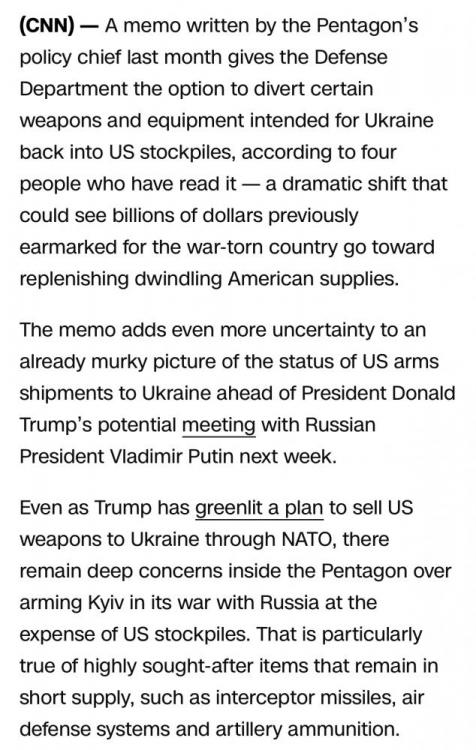
The US is in short supply yet Europe is supposedly going to step in with their much higher energy prices, beurecracy, and cutting of welfare safety nets and public funding that were already under strain before the war even began. Social services that are expected in a social contract which will have to be broken for empire war games (and 5% spending) with a geographical neighbour you can’t magically wish away and that people will politically revolt over. Far right isolationist, anti-establishment nationalism here we come baby. -
6 hours ago, BlueOak said:@zazen
Premise:
If we take multipolarity seriously, then what you call Russia’s natural push for buffers has an equally natural counterbalance: Europe’s balancing and denial. That’s the security dilemma, not a moral failure or a reason to demonize in your recognition of it. Spheres explain behaviour, they don’t confer rights or vetoes. Again recognising a multipolar world isn’t capitulation; it’s a competitive coexistence (Something i've resisted accepting). In such a system, small states have agency also: Ukraine, Poland or Georgia aren’t just buffer zones, without recognition of that, we have eternal conflict using them as pawns. In a region with clashing ideologies, history and cultural memories over a thousand years of it, friction is predictable; you aren't acknowledging that enough. Yes, the standard should be consent and non-aggression, but not deference to a power’s sphere because you or I favor its position. Europe rearming and backing Ukraine is a predictable and normal balancing response.
What should Europe actually do?
Me:
Strong united front to keep their sphere pushing toward Russia, nukes in Ukraine to mimic Belarus, keep pushing back. Until we can start to consider smaller states sovereignty as a globe. Russia isn't developed enough to do so yet. I'm just going to be blunt @zazen you reason from a place that doesn't yet exist. Which is noble and useful to point out better solutions but flawed in practicality.
About your premise: The point is Russia wants a buffer and the West doesn’t - it denies this as you said. Balancing is acknowledging each others limits and red lines - not erasing them because of an imperially entitled mindset to the globe as your sphere of influence and dominion.
Russia wants multipolarity and strategic depth. Europe/US wants a unipolar Western vision based upon primacy and supremacy, not balance.
Spheres explain behaviour but also impose structural constraints upon nations within that sphere. Like I said, sovereignty exists on a spectrum - small states don’t get to behave like global actors just because a liberal framework tells them they’re sovereign and equal. Should all states now get veto power because they’re equal? This is a romanticised view of sovereignty and agency that divorces itself from real world power dynamics and the consequences of denying those dynamics.
Can Scotland or Wales simply start allying with China or Russia and integrate their military systems because their sovereign - will UK allow this simply because it’s lawful for them to do so?
Legality doesn’t override survival and power dynamics - laws exist to buffer against power dynamics and mediate power itself, not deny power all together and confer absolute sovereignty to everyone - which has no basis in reality. Every country can’t identify as or be a pole when it lacks the gravitational pull of one. Countries don’t exist in a vaccum with absolute sovereignty and freedom from consequence when the context they exist within is denied.
This is the tension you keep running into - between power (law of the jungle) vs principle (law itself). The world exists with both - and denying the other gives a distorted view of reality: either too idealistic / utopian or too inhumane and barbaric. Principles (rights) needs to be balanced with the reality of power (might) - we can’t wish away survival or power dynamics only manage them - which is what multipolar frameworks should do.
It’s not about “favoring” Russia’s position or “deferring” to its sphere. We need to recognize the structural reality that power and geography impose limits - not to justify them morally, but to avoid war.
Buffer states don’t exist because great powers are entitled, but because peace demands space. A buffer isn’t a moral concession but a strategic compromise. Ironically, a buffer state keeps more of its sovereignty through neutrality than it ever would as a pawn locked between two rival tearing it apart.
Sovereignty doesn’t mean you can do whatever you want, wherever you want, and call it peace because it was “consensual.” Consenting to certain things, bring consequences that laws can't always protect you from. As I said - survival and power dynamics can’t be overridden by legal abstractions.
About what you think Europe should do:
You reason, like many others here do - with a liberal Utopianism that overlooks survival and power dynamics. So much for Leo constantly mentioning survival survival survival - the lessons of which haven’t been learnt.
The West isn’t developed enough to respect a larger states red lines that ensure their security, as well as the worlds through a buffer zone between rival powers.
Your solution literally calls for Europe pushing their sphere towards Russia - how is that a mature way to exist in a multi-polar world? Where one pole insists to be the only one that can infringe upon and eventually gobble up all others because it’s entitled to the entire globe as their sphere? That’s the whole problem to begin with.
Multi-polarity isn’t like an Audi logo where one sphere can just push into the other and they co-exist without friction. It’s more like tectonic plates with cushioning (buffer states) between them.
-
Claude:
- The Geological Constraint
Both Europe and China face the same fundamental geographic limitation: high population density relative to domestic energy and agricultural (mainly lacking in China) resources. This creates an inherent vulnerability - both regions must secure external supplies to maintain their civilizations at current scales. This isn’t a temporary policy choice but a permanent structural reality that shapes their strategic imperatives.
- Historical Responses to Resource Constraints
Europe’s solution was expansionist - colonialism, mercantilism, and later financial imperialism allowed it to extract resources globally while maintaining control over supply chains. This worked for centuries but required military dominance to sustain.
China’s response was the opposite - retreat into autarky, accepting lower material living standards in exchange for strategic autonomy. The Middle Kingdom model prioritized self-sufficiency over expansion, but at the cost of technological and economic development.
- The Modern Convergence
Today’s situation presents both powers with the same optimal strategy: peaceful trade relationships that secure resource flows without the costs of military enforcement. Both would benefit enormously from stable, long-term commercial partnerships with resource-rich nations like Russia, the Middle East, Africa, and Latin America.
Europe’s Strategic Confusion
Europe is acting like a would-be hegemon while lacking hegemonic capabilities. It’s adopted American-style rhetoric about “rules-based order” and primacy, but lacks the military, energy, and financial independence to back up such posturing. This creates several problems:
• Resource Security: Antagonizing suppliers (Russia) while lacking alternatives creates vulnerability
• Strategic Autonomy: Following US policies that may not serve European interests
• Economic Efficiency: Sanctions and trade wars increase costs for resource-dependent Europe
• Diplomatic Capital: Hectoring developing nations about “values” while lacking leverage
China’s More Rational Approach
China, having learned from its isolationist mistakes, now pursues what Europe should: commercial partnerships without ideological demands. Belt and Road Initiative, BRICS expansion, and resource deals with sanctioned countries all reflect recognition of China’s geological constraints and the need for diverse, stable supply relationships.
- The Tragedy of European Policy
Europe could be China’s natural partner in creating a multipolar world based on trade rather than domination. Both need resources, both have technology and capital to offer in exchange, both benefit from stable international commerce. Instead, Europe has chosen to play junior partner in American primacy games it lacks the power to win.
This misalignment between Europe’s structural position (resource-dependent, militarily weak) and its policy stance (primacy-seeking, sanctions-heavy) creates the very instability that threatens European interests. A resource-constrained region picking fights with suppliers while lacking energy independence is strategic suicide.
The irony is that Europe’s colonial history should have taught it that resource extraction through coercion requires overwhelming force - something it no longer possesses in a multipolar world. -
@PurpleTree Should Russia or China station nukes in Mexico and call it a day? lol assuming that’s sarcasm - I commented on your EU thread regarding how they could play the situation.
Like I wrote above - be part of a diplomatic effort to end the war and establish a security architecture that acknowledges red lines. They need to stop being maximalist in their demand - total defeat and fracturing of Russia (as Kaja said). Cut losses now which means conceding some territory - they will resist that because they think that territory can either be taken back or Putin may give it up with pressure (more sanctions).
They don’t realise who has the leverage here - they can’t assess the situation clearly due to ideological blinkers and inertia of their supposed place in the world. The rational is that because you used to be great powers (colonial) and are hinged to a present day superpower (US) you are invincible and can unilaterally dictate terms.
Imagine if the Turkey deal was agreed in March 2022 - which US/UK elites torpedo’d thinking Russia could be bled dry. Since then Western stockpiles have gone down to worrying levels, 100’s of thousands more deaths, some more territory loss, more destabilisation of the Ukrainian economy to where it’s dependent on Western support - support that’s increasingly becoming conditional (EU forced to buy US weapons) or resented by native populations needing those resources for themselves.
Humbling I think is needed - which I think the US is slowly receiving. Between the Red Sea debacle (Houthis) and Iran and Israel’s showdown - they have assessed they need to go to the drawing board and save their resources / find alternatives methods (trade/tech war) of containing larger threats (China) to their primacy.
In just 12 days 25% of US THAAD interceptors were destroyed defending Israel against Irans missiles. What if that continued? Pakistan shooting down a western Rafael jet with a co-made Chinese Jet was also a wake up call as to how things may go down against China. Hegseth even said clearly that US loses to China in a war game scenario every time.
It seems the EU didn’t get the memo and are still parroting US empire logic and talking points (due to inertia) - meanwhile that empire is de-prioritising Ukraine for larger game they know they aren’t ready for but need re-arming for.
On 15/08/2025 at 6:22 PM, zazen said:Europe needs bold leadership and tact to extricate itself from US vassalization and develop strategic autonomy + start acting in its own interest.
It mainly needs strength and sovereignty in energy, military and industry (tech included). Those form the basis for political/diplomatic sovereignty - without the former the latter have no teeth as their structurally limited and constrained by hard power. Your softness (good hearted values) need the backing of hardness (grounded power in the material world).
Every state or entity has to use its own advantages - for Europe that would be its geographic positioning (not such its geology). It’s connected to the largest landmass on earth connecting it to the rising (already risen) powers of Asia (China) and resource rich Russia and Middle East. It’s also north of Africa with plenty of resources and an ocean away from the US (largest consumer market).
Europe actually benefits greatly from peace and connections it’s already positioned for - rather than a continent of confrontation against Russia. It needs to put itself first before US alignment - and embrace multi-polarity - recognizing and embracing itself as one of those poles rather than being in the shadow of the US.
It should re-engage with Russia (regardless of US dictates) and benefit from cheap energy for its industry, whilst investing in energy connections to North Africa (to diversify), whilst investing in domestic sustainable energy for the long term (to not become so dependent). It should re-shore critical industries (for national security) and go all in on technology which is critical for the world we live in.
On the political front it’s probably best it doesn’t act so brashly and defiantly (speaking openly against US reliance) - but just build quietly in the background to not invite any hostility or US resistance that will try to maintain the status quo (hence I started by saying it will require tactfullness).
-
22 minutes ago, PurpleTree said:You could call it western encroachment. Or you could call it countries like Ukraine, Armenia, Georgia etc. want to move the fuck away from you (Russia, Putin) and closer to Europe because they’re just not that into you.
You could call it Western encroachment or fuck around and find out. What utility to does NATO get from including Georgia and Azerbaijan except antagonising Russia? Maybe what those countries “want” isn’t worth WW3?
This isn’t geopolitical tinder where a country can swipe right on whoever they wish because democracy voted for it - sure though, they get what they vote for, including the consequences and reality of power politics that the liberal minded like to image they float above.
What about the Gallup poll showing most Ukrainians want an end to the conflict - but that a political elite class in Europe still want to push them to die for? Where’s democracy now?
Euro elites are sounding a lot like neocon hawks - atleast US neocons lived far away from their wars and consequences. Eurocons seem to be retarded enough and ideaologically corrupted enough to push for more war on the same continent they live on.
-
23 hours ago, BlueOak said:Let me give you an objective conclusion. Whatever Europe doesn't buy others do, but for less (However even china has run out of room or need to store excess oil). So the war has run on far longer than it ever would have in a uni polar world. On your sanctions point, given the population density, actual trade from the US to India is quite low, which is they've already gone ahead with sanctions. This isn't true of China, which why it isn't sanctioned. Also the EU - India and EU - China trade is actually very high.
However the world is split, and sanctions are required. BRICS is trying to outcompete the West, thats their stated goal. Why on earth when we want to work with them? You seem to imply however, that sanctions wouldn't hurt them; in actuality it would hurt everybody.
Two competing global power blocks is a recipe for competition, conflict and WW3. I think i've said this 5,000 times at this point.
*Also you seem think people can just buy up energy indefinitely, to do what with exactly? The reason Europe and the US buy so much is because their countries are so energy hungry; not many other places are. Oh and the US has an oversized fuel-guzzling, globally polluting military.The war was caused by conditions set by a unipolar hegemon not accepting a multi polar reality. Is the world supposed to remain orbiting around the US forever, even as others rise?
The world is split because of sanctions - more so because of the unipolar primacy seeking mentality behind them. Sanctions are required? More like sanctions cause other countries to require alternatives like BRICS that won’t finger wag them if they don’t get into line.
BRICS doesn’t exist to destroy the West. Competition doesn’t mean destroy - and the West are the ones who insist on not cooperating or competing by sanctioning those they see as a threat to them being on top of the competition. Asking why the West should work with BRICS if their trying to compete is the type of zero-sum hegemonic mindset of: if their not under us they must be against us. Schoolyard politics.
Not working with them cements the very split and bipolar world of competing blocs you fear can lead to WW3. Blocs or multiple poles doesn’t mean war - unless one bloc or pole can’t accept the legitimacy or existence of another. Obviously multiple blocs or poles brings with it complexity - but that needs to be managed with new and updated institutions and a security architecture being created (like what Putin mentioned in Alaska) that includes security for Europe also.
What else is the option here? Keep being hawkish with Russia and eventually have Europe go to war with them? Over what.. why not just make a security architecture that acknowledges red lines and benefit from peace and trade as Europe had done in the past with cheap Russian energy.
Regarding Russian energy exports - others buy for less but can buy in higher volume as their growing markets as opposed to stagnant plateauing ones. India has absorbed approx 80% of Europes volume and has huge runway for growing energy demand as its young 1.5billion population urbanises and develops more. Even if it buys at discount - the volume will offset the loss within years.
Chinas building another pipeline (Siberia 2) that would replace half of EU’s gas imports. The remaining gap will be filled through LNG and terminals being invested in and built for processing that LNG.
@PurpleTree Yeah, he’s using narratives that resonate domestically to justify what is at core, a geopolitical red line over NATO expansion and Western encroachment.
I don’t have to believe every Russian talking point that twists half truths into something they’re not. But I can still see the facts on the ground that are a geopolitical reality. Just gotta dismiss the nonsense exaggerated propaganda whilst seeing the principles of security logic that any state would be acting in accordance with regardless of the propaganda they feed their domestic population.
Proud civilizations can’t keep bitching about feeling scared of other nations or civilizations (Western bloc) encroaching on their periphery as it comes across weak. They need some saviour crusader rhetoric overlayed on top of actual security concerns.
-
On 16/08/2025 at 9:22 AM, BlueOak said:@zazen
You should look at the granular details; it'll give you a more realistic portrayal of the war, not just dramatic headlines. Russia is slow and steady, Ukraine is stubborn to withdraw to inflict high casualties; this has been the pattern since day one, for the most part. Russia use human wave attacks and technicals (civilian vehicles) because of drones and the damage done to their armour, largely by drones now or previously in years gone by, overextending.
Russia has achieved its goals. Which goals? - Goals (from all sides) change every month in war, to the practical reality of what's possible, for example initially it was to take (retake) Kiev, which failed early on, and Ukraine's was to kick Russia all the way out, which was never going to happen either.
Russia is printing about 20% of its money every few months now (was 15%, now 19% if I recall). Its economy, which is almost completely switched to a wartime footing, is not sustainable, and when the war ends, then what? BRICS has propped it up really well. At the cost of Russian industry becoming Chinese. Part of this is explained below:You rightly note Russia’s large industrial base and drone production increasing into a wartime economy. But attritional warfare isn’t just about making more, it’s about preserving enough quality force to win politically. Drones don't really fill that role yet, they are more equivalent to missiles. Russia’s been burning up elite units for marginal gains, and the demographic clock is increasingly not on their side. It’s increasingly using aged conscripts, 50's era armor, and prison battalions, not signs of sustainable strength. -
Yep, Europe is slow to mobilize industrially. But that’s not the same as being incapable. The EU is not a battlefield power; it’s a bureaucracy built to avoid war. Yet under sustained pressure, it can retool, especially if US support contracts (and the US military industries rush to fill the void opening overseas). That’s exactly what’s starting to happen now in France, Germany, and Poland. Have you seen how many companies returned their products to Russia, or Russia just mimicked their brands? They all just changed their name - that happens when the US officially pulls its support back from Europe, people move in to fill the void. Nothing changes when demand is there, only the cost.
Yes the Europeans didn't retool that much, though 5% GDP is no joke over the EU's scale. Ukraine aside, they didn't spend any manpower or weaken their demographics, trade partners or really suffer much at all. Aside from energy prices, which they've gone elsewhere for. Russia has weakened itself to gain a fifth of what it had previously. I'll restate: Europe is a bureaucracy built to avoid war. - I hate people don't realise this. - When I now grudgingly call for the rearming of Europe i understand the historic implications of doing so, thousands of years of expansionist war
Vassalisation
You think the US being the military powerhouse, and Europe sitting back is vassalisation? It certainly costs them their voice with Russia, I'll give you that. Which was always amusing, as potential force should be considered alongside force by a wise mind. I don't need to see force to understand its possible or there.
It's just Europe being geared toward a peaceful life, happy to sit back, live the high life and let someone else take care of security.
But that's not accurate anymore, this war woke them up. America is clearly trying to pull its influence back, and these countries are spending 5% of their GPD on defense now, which will be used in some form. It won't sit there doing nothing.
To conclude
Russia spent a million casualties on retaking 20% of a country they've controlled 100% via proxy, with ruined settlements and barely any population living there. They've tanked their economy. They've gained stronger BRICS allies, some minerals, some important ports. They've lost much of their youth to death, disability or leaving the country to set up lives elsewhere. Their demographics are worse than ever, much of their economy is chinese and they are more a proxy of China due to reliance on Trade, Chinese investment in Russia and the sheer power of China relative to Russia when not balanced out by European influence or allies.
I liked chat GPT's take here, I won't give you all the points but:
- The goal has been to weaken any threat on its Western flank (tactics changing accordingly to the field). Ukraine is weaker now than it was before the war began - including material support from the West which is running low on stockpiles and fragmenting due to domestic politics, economics etc. They’ve gained strategic depth away from Russias core interests and capital (Moscow) whilst securing sea access if the West were to attempt containing Russia via sea. Ukraines industrial heartland being taken now makes them dependent on the West who will have to bleed their own resources (that domestic nationalists are fighting over keeping for themselves) to prop up what is now becoming a rump state. Loss of life on both sides has been brutal but from the Russian side this is seen as existential to them: a sacrifice against a bloc that is hawkish / hostile and looks to contain their country (spelled out in policy documents and think tanks).
A recent Gallup poll shows 69% of Ukrainians wanting an end to the conflict - much higher than before. Fatigue has set in: https://news.gallup.com/poll/693203/ukrainian-support-war-effort-collapses.aspx
- Russia has a cohesive population thats more easily mobilized against a threat they perceive as existential / within a national security logic. Compared to much of a continental Europe who don’t view Russia as threatening to the same degree (geographic distance to the West) and are divided in loyalty due to multi culturalism - many ethnicities don’t want to bleed for a host nation that colonised their ancestors. Even the nationalism that’s arriving is isolationists not expansionist - people are sick of wars that served elite interests while hollowing out the middle class due to financialization. People would rather protest war than confront Russia in a show of “force”. There’s also no unified command structure across multiple nations with their own foreign policy and military doctrines. NATO has it but that’s lead by US who don’t want to go kinetic against Russia and risk WW3 carnage - which is why buffer states like Ukraine and now the South Caucus are used for plausible deniability whilst continuously pursuing primacy.
Even if the most keen to fight nations combined their fighting age men (Poland and Baltics due to proximity to Russia) Russia still outnumbers them. On the surface Europes manpower is more - but their important details to account for.
- The demographic and economic woes cuts both ways (Russia’s median age is 42 vs EU’s is 45). Likewise with finances - Russia has one of the lowest debt to GDP’s ratios (20% vs a EU average of 80% with some countries over 100% like UK, Italy, Spain etc) This is why Spain has completely opted out of the new push for defence spending and the others have only just symbolically gestured that they will increase spending but not yet laid out any budget or plans on how to do so and where to cut from. Industry is kneecapped due to higher energy costs - yet they want and need more money to spend on defence and a aging population who’s used to and expecting a welfare system to take care of them: this is going to strain and push things politically to the right and against militarization and war even further.
- Sovereignty exists on a spectrum. I think you overextend things to fit into definitions they don’t belong. Such as Russia being a vassal of China because it happens to do a lot of business with them. Russia hasn’t lost autonomy or sovereignty, and still runs policy independent of that relationship. No doubt trade brings leverage over another - and a globalized world includes trade dependencies: but the type of trade and context matters. Is it being weaponised? Is it critical? China hasn’t (yet) weaponised its trade and Russia still has resource riches and its own military industrial complex.
Military, energy and industry create a strong foundation for sovereignty- which is why the EU lacks it. Just like you mentioned: Europe is a bureaucratic peace project - peace many people are used to and don’t want to disrupt by being hawkish against Russia (counter to their political elite). Peace that meant they could have a welfare state (already struggling) that will now be struggling further because of that hawkish posture with a 5% defence spending aspiration. They outsourced security to the US which made them largely subordinate to the US. It’s designed structurally to be pacifist due to its beuracracy which entails fragmented decision making, internal divisions and contradictions, and no unified military command as I’ve already mentioned. It’s energy dependent and militarily dependent and secured by a US led NATO umbrella.
This is an issue of geology - it simply lacks enough resources to energise itself: which was overcome in the past through colonial expansion that is no longer a possibility. This puts Europe in a difficult position where it needs to fight for its sovereignty and hinge it on external actors. Even overcoming their lack of energy sovereignty through sustainable energy requires dependence on Chinese dominated green tech supplies (batteries, rare earths, solar panels). Clean energy still succumbs to dirty geopolitics - but that doesn’t mean the game needs to be played dirty (country X vassalising country Y because of its asymmetric dependence) ie if China were to abuse this dependence.
- Just because Russia gets some components from China doesn’t make them a vassal, - by that metric the world is a vassal of Taiwan for supplying critical semi conductors or to China for supplying rare earths. China doesn’t go around telling countries who they can and can’t align with or work with - there’s no strings attached except pay for what is provided. Otherwise it would use its leverage over Pakistan to cut ties with the US and not deal with them. It’s this reason why many countries want to deal with China - because it doesn’t demand political and foreign policy loyalty in exchange for its trade. Meanwhile the Western financial system (SWIFT) is weaponized via sanctions which is a driver of countries wanting a parallel system (BRICS) that can’t unilaterally punish them.
Mexico isn’t a vassal of the US for being the largest trade partner and neither is Japan a vassal of China for being its largest trading partner. Japan has military and political autonomy from China and is clearly an ally of the US in most people’s minds. Meanwhile much of Europes foreign policy and military is tied to US dictates including its only cohesive security umbrella (NATO) which they would be fragmented without.
- Your conclusion says Russia controls Ukraine 100% by proxy - but that’s opposite to the case. It’s because Ukraine was increasingly behaving as a proxy of the West with NATO ascension promises that caused the war we now have. If Ukraine was 100% a proxy of Russia then Russia wouldn’t have sacrificed its million men for a measles 20% of Ukrainian land as you said.
A question to ponder is: What would the UK do if Chinese or Russian military systems were parked up in Wales or Scotland? Even if Russia / China portrayed themselves to be simply defensive in nature - coming with dumplings and vodka in hand. Would and should the UK allow this simply because it’s those countries democratic right?
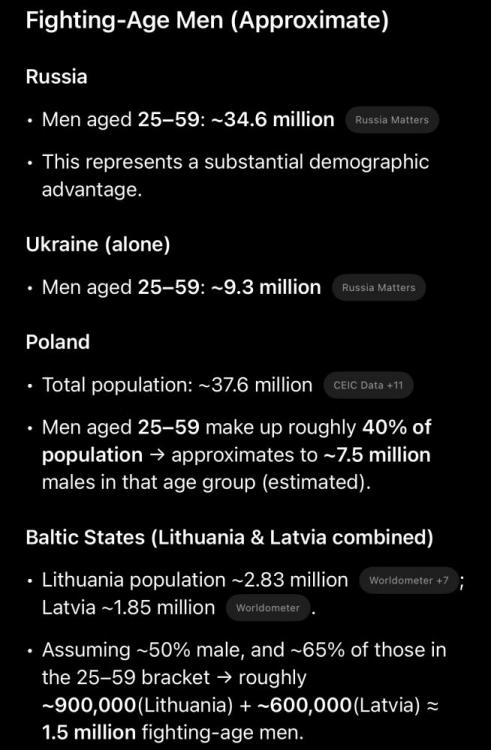

-
Europe needs bold leadership and tact to extricate itself from US vassalization and develop strategic autonomy + start acting in its own interest.
It mainly needs strength and sovereignty in energy, military and industry (tech included). Those form the basis for political/diplomatic sovereignty - without the former the latter have no teeth as their structurally limited and constrained by hard power. Your softness (good hearted values) need the backing of hardness (grounded power in the material world).
Every state or entity has to use its own advantages - for Europe that would be its geographic positioning (not such its geology). It’s connected to the largest landmass on earth connecting it to the rising (already risen) powers of Asia (China) and resource rich Russia and Middle East. It’s also north of Africa with plenty of resources and an ocean away from the US (largest consumer market).
Europe actually benefits greatly from peace and connections it’s already positioned for - rather than a continent of confrontation against Russia. It needs to put itself first before US alignment - and embrace multi-polarity - recognizing and embracing itself as one of those poles rather than being in the shadow of the US.
It should re-engage with Russia (regardless of US dictates) and benefit from cheap energy for its industry, whilst investing in energy connections to North Africa (to diversify), whilst investing in domestic sustainable energy for the long term (to not become so dependent). It should re-shore critical industries (for national security) and go all in on technology which is critical for the world we live in.
On the political front it’s probably best it doesn’t act so brashly and defiantly (speaking openly against US reliance) - but just build quietly in the background to not invite any hostility or US resistance that will try to maintain the status quo (hence I started by saying it will require tactfullness).
-
- Yeah the elite units were sent but that’s the point. Theres an ebb and flow that causes the attrition to take place. Units being sent to plug one hole means they’re concentrated in one place to be attacked, in addition to thinning out defences in other parts along the line.
The whole point is to grind down the other side. Russia is now also producing drones internally and at industrial scale. Even nastier ones with deeper range and payload.
- As already mentioned, the main goal isn’t KM’s gained but is mainly neutralising a forward base and threat on Russia’s border. That has now been achieved in large part - though not in totality. Even if we are looking at KM’s taken - they’ve got 20% of Ukraine and 80% of Donbas which is the industrial heartland of Ukraine. Also a secure land bridge to Crimea further securing it and deep sea access. Theres not much else for them to gain going further into hostile regions difficult to hold and nearing a NATO border - so just dig in where they are and keep grinding down Ukrainian capability.
- I don’t believe Ukraine is collapsing as much as I don’t believe Russias economy is collapsing. That doesn’t mean they aren’t suffering - both parties bleed in a war. The point is who can bleed longer. The main factors in a war of attrition are: manpower, arms (industry) and political will. Russia can outlast Ukraine and seems to be outlasting a Western bloc (NATO) that’s been supplying Ukraine, yet running low on supplies and the political will to keep things going.
The EU has a war on its doorstep yet hasn’t ramped up industrial output - Russia is still outproducing the EU and US combined. No one’s sending troops from beyond Ukraine in any meaningful number as there’s no political buy in to die for this war. And the political will to keep funding Ukraine who’s reliant on that funding is drying up and fracturing. Even the US defence deal with EU - the Mediterranean countries are backing out and leaving the North and Germany to foot the bill - a Germany that’s economically weakened and slowly de-industrialising due to high energy costs thanks to yours truly blowing up the pipeline.
- Russia and most states for that matter will always prioritise security concerns before worrying about who wants to be their friend- they don’t care to be invited to Eurovision. EU leaders saying their backing Ukraine is good and all but it needs some teeth. NATO is their military umbrella led by the US and has changed its tone accordingly - which just shows the level of vassalization of Europe.
- I agree that Europe need their own industrial, military and energy sovereignty to not rely on the US or follow in their footsteps. Spain, France and others don’t want to buy F35’s because they want domestic strength which is a good start. The irony is that they still speak US empire talking points and still maintain a vassal mentality that wants to keep fighting a war not even in its own interest: a war now being de-prioritised by empire to retain dwindling resources needed for a pivot to China and perhaps Iran. Europe mostly don’t have the political will, capital, energy or industry to go at it alone against Russia - at least not right now.
To get to that stage will take time and dedication, hopefully not sabotaged by a US that prefers a Europe tied to its interests rather than its own - that’s the hurdle the EU has to overcome: strengthening itself whilst under the vassal of the US who will resist that change in dynamic. And not just in a material sense but in a mental sense - which is still showing up in their rhetoric and behaviour.
EU complains it’s not sitting at the table but denied any negotiations with Russia the past 3.5 years. Now that they’re not at the table they rightly intuit that they must be on the menu. Used as a pawn in a larger geopolitical game they don’t have the sovereignty or strength to dictate terms in - but that hopefully they pursue. And not to use “force” against Russia but as a deterrent.
- I don’t usually pay attention to granular details of war due to fog of war and propaganda. But I looked into things recently and see even Ukraine sources talking worryingly - so I deduce my conclusions from that alongside looking at the macro situation which is that Russia simply has more depth of manpower, industry and political will to grind the other side down further.


The above is what I meant in my first point - that plugging one hole leaves others areas along the line vulnerable. This is just from this morning and from a Pro-Ukr source.
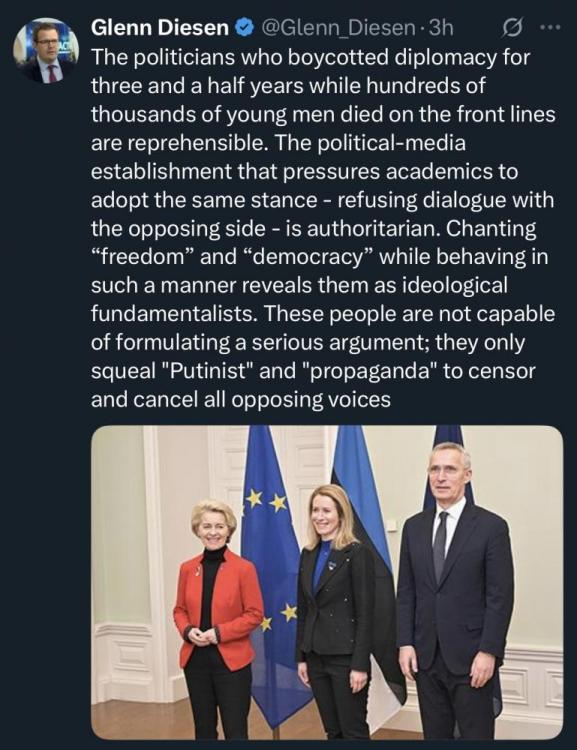
This is what I mean by fog of war and not knowing what to believe regarding casualties. Never seen Douglas McGregor get feisty like that in a interview:Even if we take a rough estimate of casualties- per capita and for its size, Ukraine is still suffering more losses compared to Russia. Tough to know exact figures so it’s a grey area I stay out. But I don’t see why McGregor would be lying and assume he’s got good sources.
-
First 10 min of this video in insightful as to what kind of a war is taking place (attritional) and how territory gain is only secondary to the aim of attrition.
The recent break throw helps strengthen Putins hand in tomorrow negotiation.
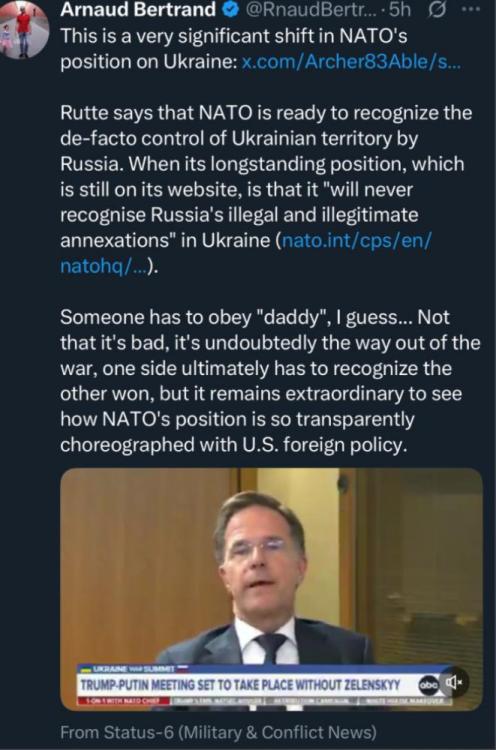
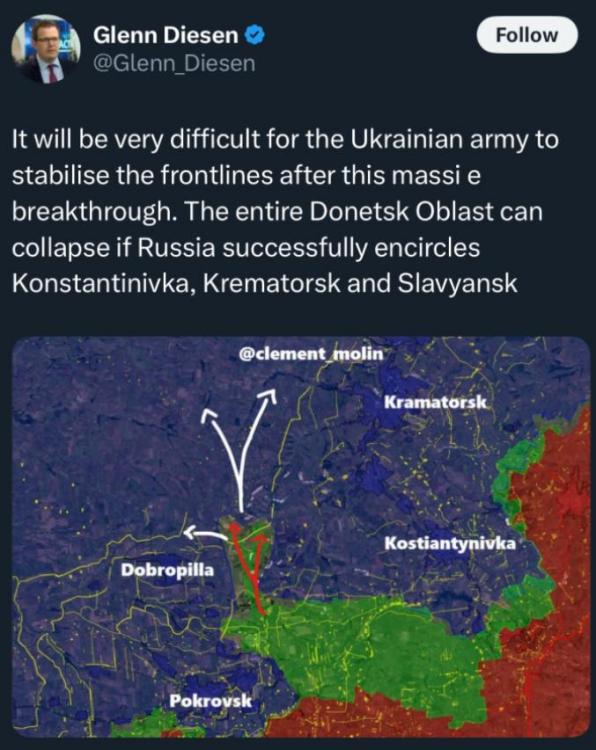


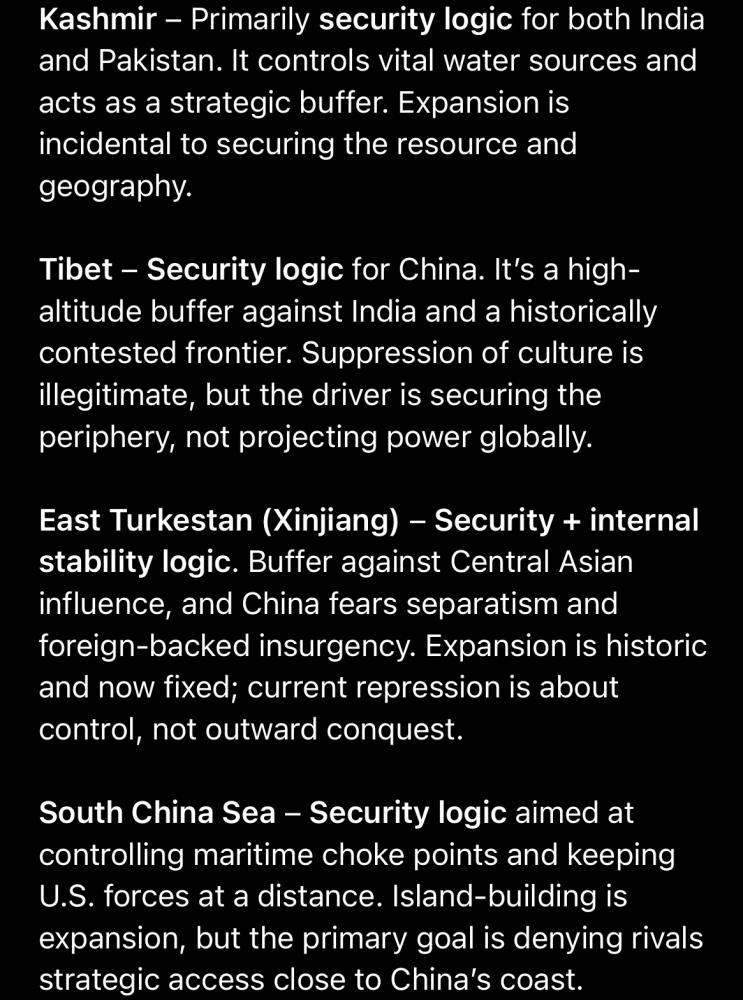
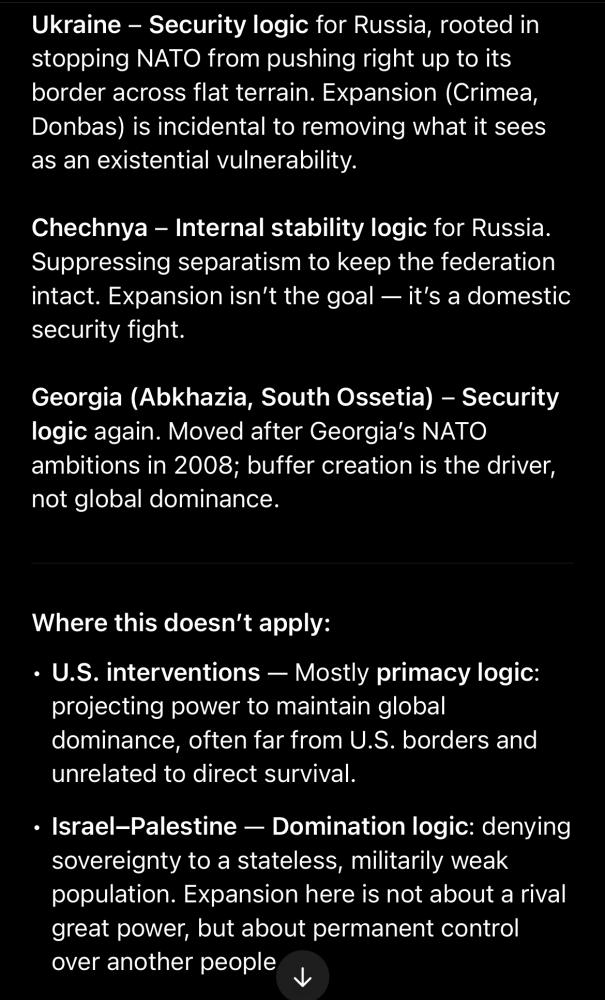
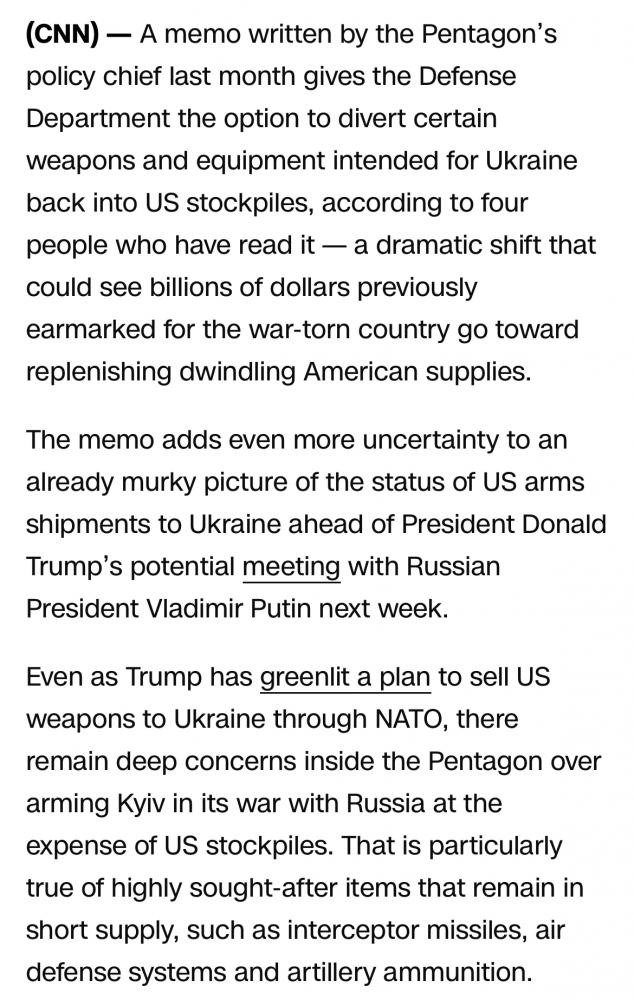
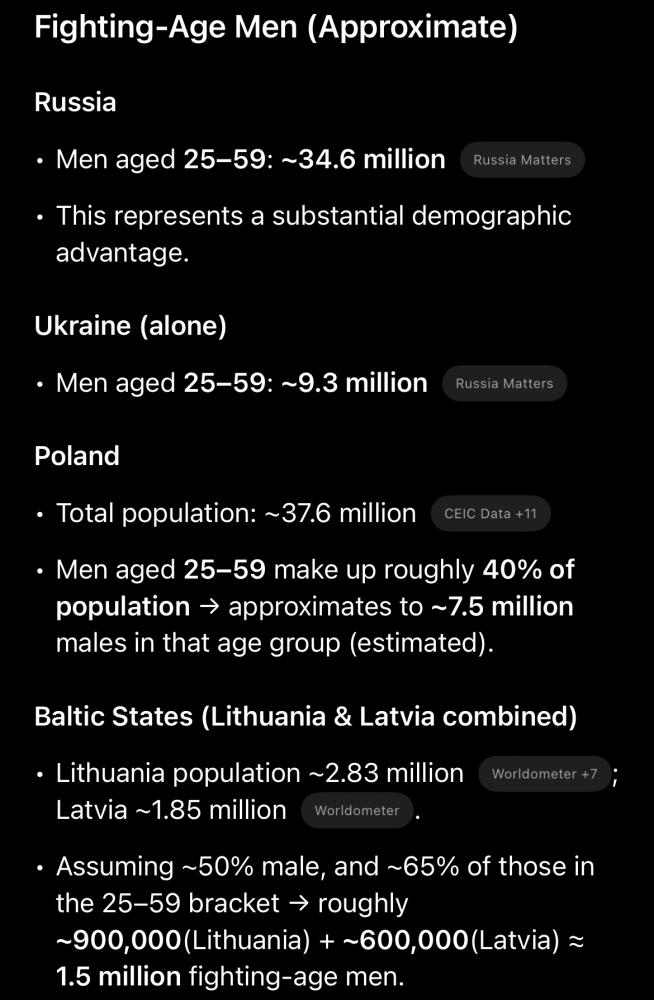
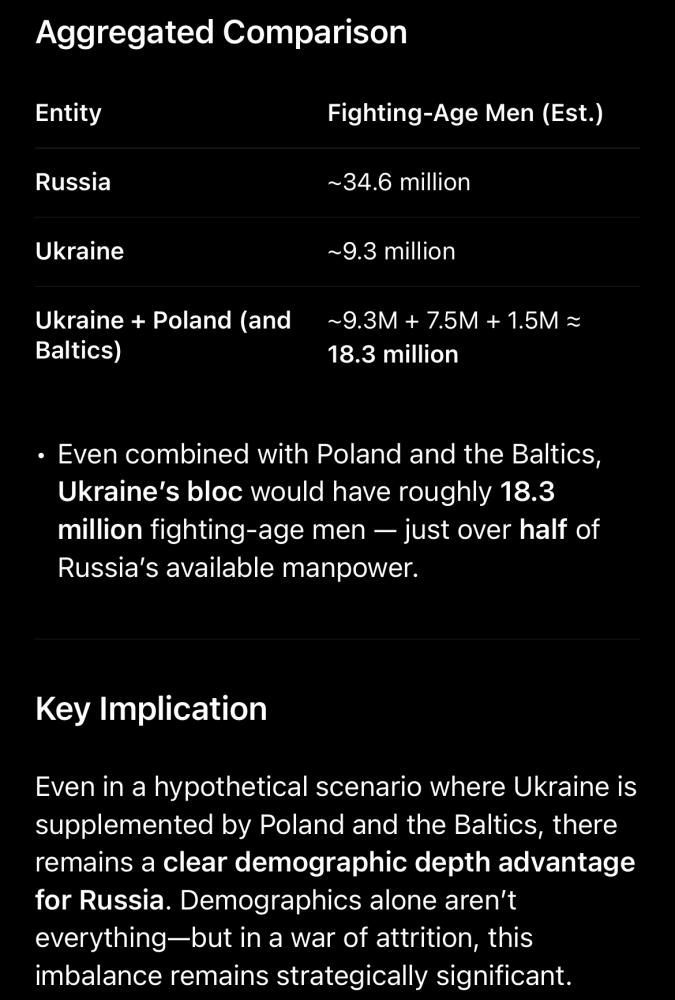


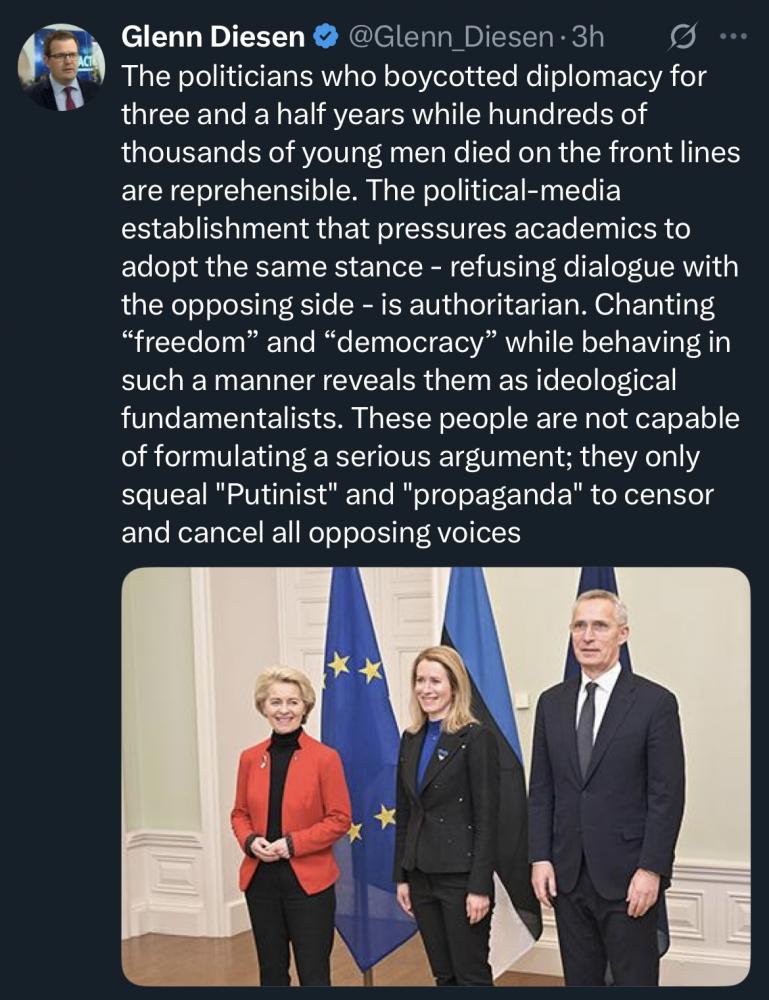
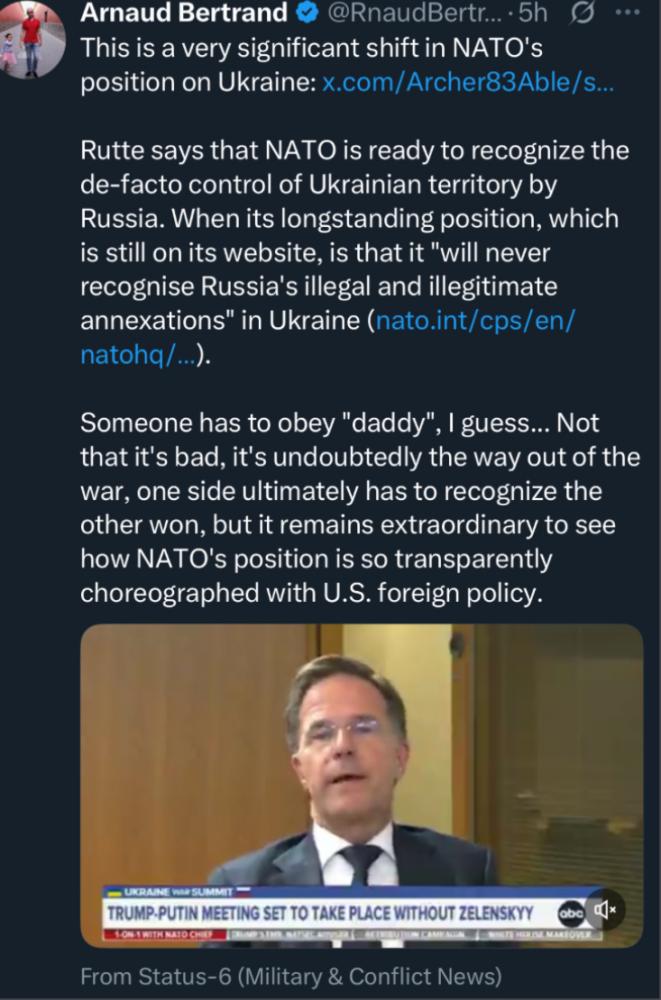
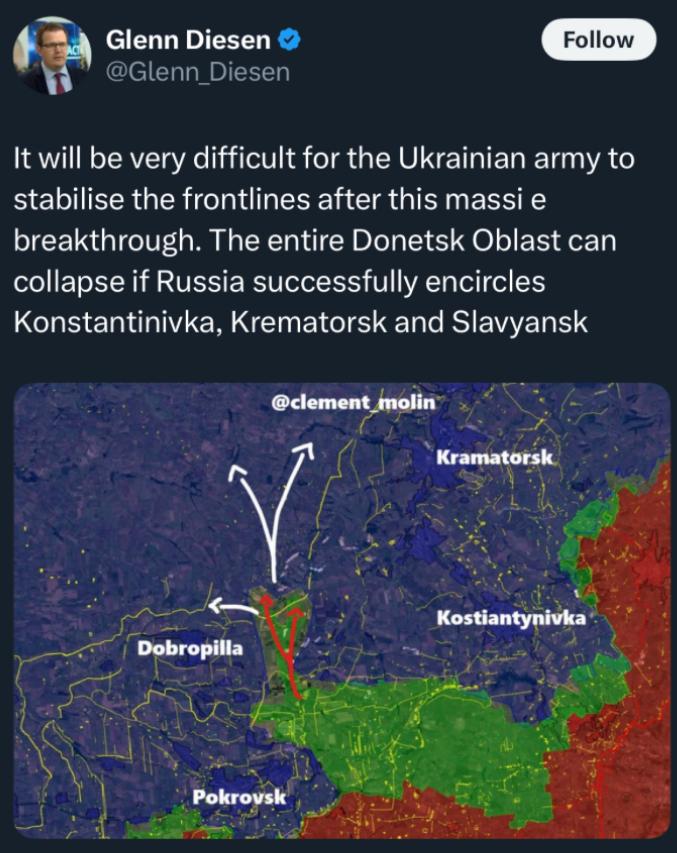
in Society, Politics, Government, Environment, Current Events
Posted · Edited by zazen
To produce requires the consumption of energy - which both don’t have enough of for their size and speed of development. China and India are the largest energy consumers in the world alongside EU and US. Both require more consumption and have room for growth - especially India as it’s still developing.
Both have locked in with Russia which means for the foreseeable future Russia will be able to sustain itself economically. Both have also brushed off the secondary sanction threat.
Arnaud:
''Imagine if Europe had done this with Russia (India resetting ties with China) when Trump started, like he just did with India, to go hostile on trade. Not only would they not be in the absurd situation where they need to negotiate peace with Russia via the intermediary of a hostile Trump, but they also could be rebuilding ties with Russia as leverage against American extortion.
And I'm not even speaking about avoiding the pathetic spectacle of being lined up like schoolchildren before Trump's desk, or having to pay several points worth of European GDP in tribute. Now they get the worst of all worlds: public humiliation as American vassals, systematic wealth extraction by the US, a ruinous proxy war they need to pay for, and continuous hostility with their next door neighbor even when, ironically, the US is now restoring relations. In some way it's even politically harder for India to do this than it would have been for Europe vis a vis Russia: the level of animosity towards China of the Indian population is probably greater than that against Russia in Europe.
Heck, European leaders would undoubtedly have been cheered by a large proportion of Europeans if they'd taken the diplomatic initiative in Ukraine instead of Trump, all the more if it was as a strategic move to resist Trump. But no, they'd rather sit in the Oval Office like obedient pupils, write $100 billion checks to American defense contractors, and continue playing vassals to a hegemon that openly despises them. Europe doesn't lack the capability for strategic autonomy - it lacks the will, the courage, and apparently, any sense of shame.''