

Carl-Richard
Moderator-
Content count
16,219 -
Joined
-
Last visited
Posts posted by Carl-Richard
-
-
I have a thing for playing fast on guitar. I also like to spend most of my time improvising, often while playing as fast as I can. I very rarely spend time learning songs or things that others have made. But when I do, I find myself using the "start slow and increase speed slowly" approach. But again, because I improvise a lot, I rarely do this, so I just spend a lot of my time playing fast.
Interestingly, this is the advice from probably the fastest guitar player to have ever lived (Shawn Lane) about learning to play fast on guitar: "Rather than going from one mental process of playing slow and getting gradually faster, you approach it from the way of playing it fast and sloppy and gradually learn to clean it up":
3:00 - 3:19Similarly, Yngwie Malmsteen, also known for playing fast, has said "I never practiced, I never practiced once in my life. Ever since I was 8 years old in my bedroom, I was playing like I was performing. I was expecting to be blown away by what I was doing, I was expecting to impress myself":
0:05 - 0:27
So both players seem to have gotten to their level by mainly jumping right into the real thing and trying to take it from there. No "slow and controlled" approach, just going straight for the real deal.
This interestingly connects to a principle for learning for school exams which says "practice the way you're going to be tested". For example, if you're going to write an essay for your exam, practice by writing essays. This is in line with a more modern and context-aware understanding of cognitive science, "embodied cognition". It says everything in the situation matters; the context, the energy, the way your fingers move; be it typing on a computer or playing notes on the guitar. It is relevant to the situation you're aiming for and how memories are encoded and how you build up the requisite skills. It's contrasted with the more traditional "symbol processing" perspective of cognitive science, which treats cognition as something that is mostly going on inside your head.The symbol processing perspective would favor techniques like flashcards, thought maps, rote revising and rehearsal. It doesn't treat context as very important. But it is. That's why "practice the way you're going to be tested" is so effective for test performance. That's why Shawn Lane and Yngwie Malmsteen are known for their speed.
Specifically for guitar, when you practice by playing slow, you might be using certain techniques that don't translate well to the end product you're aiming for. So you might end up either taking forever to get there, or you'll just never get there, or you'll get a partial version, or an inefficient version. For learning for the exam, you just might not be using the same cognitive faculties that you will be during the exam (e.g. typing on the computer, putting your thoughts into words, answering a question, answering the right kind of question), which does have something to say for the end product.
So if you want to get to a certain speed of playing guitar, or you want to learn for an exam, and probably many other things, practice the way you're going to be tested.
-
2 hours ago, Thought Art said:@Carl-Richard okay thank you for sharing that i was reply to your previous comment.
I think others can be perceived by a solipsist without applying space and time. They have a different ontological category for “others” than, they would if they were a materialist. In a dream for example a person speak of a monster they saw. But, the dreamer need not consider space and time because they know it’s a dream. There is no space and time in dreams though it appears that way.Anything that has an extension visually (not just in waking reality but also in your imagination) can be described by the concept of space. If you can draw two points and a line between them, that's space. Space is just a placeholder concept for things that extend visually. It doesn't matter if it's in a dream or not. The reason you think that is because materialists have hijacked the notion of space to mean space in waking reality (or outer space), which we can thank Descartes for when he drew the distinction between res extensa and res cogitans. But if you're an idealist, reality is indistinguishable from a dream. I linked a video earlier of an idealist that argued (from a scientific and philosophical point of view) that other people in waking reality are dream characters.
-
45 minutes ago, Thought Art said:@Carl-Richard So, my understanding of maya would that the “other/ other people” is part of maya. Notice how the other people in your life you only know your own awareness. If reality is maya, why wouldn’t other people be included in that maya and not actually exist.
Did you see the picture I posted earlier? They are.
48 minutes ago, Thought Art said:You seem to be drawing distinctions where some things are real, like other people, other minds, space and time (all of which you only experience in your mind) which you ground in some form of rationality which is again your own mind.
I draw the distinctions (illusory distinctions) for the sake of pragmatism, for understanding the illusion. I have conceded that they are Maya and not metaphysical bedrock, in this very thread.
52 minutes ago, Thought Art said:It doesn’t really make sense that reality would be “consciousness” but to ground your metaphysics in space/ time. There is not really any proof existentially in other minds, space or time. These things exist in consciousness. But, are not existing in and of them selves. They would be aspects if maya.
Solipsists are the ones who ground their metaphysics in space and time by making definitive statements like "other people do not experience". If you don't want to talk about space and time, don't talk about others, let alone if they experience anything or not.
-
If there is only now, how does anything happen at all? "There is only now" is a stupid pointer. There is only what is. Then you can divide it into pieces through conceptualization, through things like change, movement, space and time, and you can understand things like frequency (which is an oscillation over time).
-
2 hours ago, Breakingthewall said:No, there is not. Everything is in constant change. The self , the center or perceptor seems to be the unchanging receptor of the experience, but it's precisely the "illusion". It's created by the perception of change.
If change is constant, change has a changeless element to it. Change requires non-change. That's basic non-duality.
2 hours ago, Breakingthewall said:Consciousness is nothing, it's just the reality appearing as an structure perceptor / perception. It's an arising of the reality
Consciousness is an appearance. Reality doesn't need conciousness to be, but conciousness arises. As it arises it's infinite, but not absolute. It's an essential nuance
If it's constant, it's absolute.
-
-
7 hours ago, Eskilon said:It is not a certain way, it is every way possible. The connection with emptiness is that because there's not boundary or distinction between anything, everything penetrates everything else. Everything is everything else. So it can never be a "certain" or a "particular", even though it appears so. The "thing" that is enabling all of this, is emptiness of everything.
So you can't exclude anything. So apparently separate mind-body complexes can have apparently separate localized points of view outside of your own apparently separate localized point of view.
-
15 minutes ago, Eskilon said:@Carl-Richard Yesterday I said I understood your reply to me in another thread, but actually reflecting upon it and seeing this post I have some things to add here:
As I see, the teaching of the world is Maya is a pointer to the spiritual seeker to turn inward, forget the world and ultimately realize Nothingness.
But if we do a little bit of search and read around spiritual traditions, we see that there have been teachers that said that "Empitiness is form, form is empitiness". From my explorations, this is truthful, the distinction between Consciousness(the top of the pyramid) and the World(Maya) is a illusory distiction made only to direct the spiritual seeker towards the right direction. But in the end, this distinction doesn't actually exist, you could say it, in a way, it serves only to direct the seeker.
When you are looking at forms(limits) you are actually looking at the entire of reality, this is what interconnectedness, and Indras-net means. So the forms are not really limited, it is infinite too. Every part is total, complete. And with this, you get the solipsism that Leo is talking about.
There's only one total thing being reflected infinitely in every other part, it's YOU.
The problem I'm pointing out is claiming that some very specific forms are necessarily a certain way because there is no difference between form and emptiness. It's a total non sequitur. If you are claiming "there are no separate individualized mind-body experiences but this one", you can't claim that based on "form = emptiness". It's like claiming apples can't fall down or there can't be two clowns in a clown car because God is both and form and emptiness. It's a total non sequitur.
-
42 minutes ago, Breakingthewall said:Conciousness without change is unconsciousness. This is what happens when you're injected with propofol. Your field of consciousness ceases to have content, then it disappears. It can last a trillion years, which is less than an instant, nothing. The moment there's a change perceived, consciousness resets.
Consciousness without change can be known (it's always known), hence you can be conscious of it. There is always an unchanging element to every experience. Anesthesia is not "un-Consciousness". It's called unconsciousness by medical professionals who don't care about subtle metaphysical distinctions.
31 minutes ago, Breakingthewall said:It’s often said that “consciousness is the basis of reality” simply because everything we experience seems to occur within consciousness. But this conclusion is based on a confusion: we mistake the framework of our experience for the foundation of existence itself.
If you grant the unknown, anything is possible. The ground of being could be a pink elephant. But within the known, Consciousness seems to be the ground of being.
31 minutes ago, Breakingthewall said:consciousness always involves differentiation, relation, and appearance. It’s already a form.
You're mixing up Consciousness with Maya (mind-body consciousness).
-
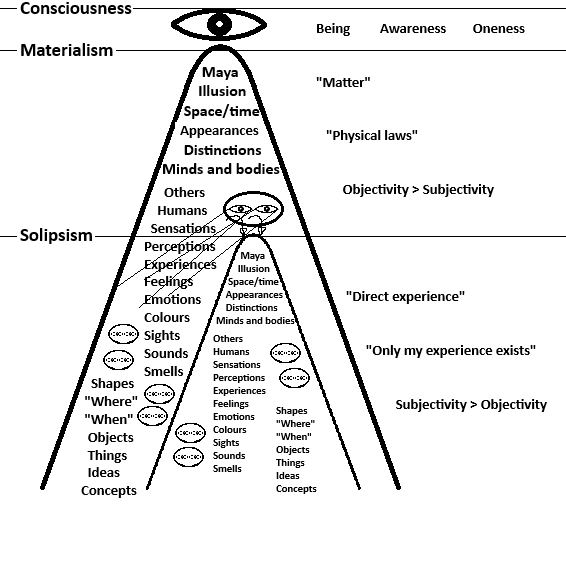
4 hours ago, Someone here said:I don't understand the diagram. Your written explanation is not clear .please clarify with more detail. Thanks .
Firstly, the cone coming out the eyes should be thought of as a visual field rather than a pyramid.
At the top, Consciousness is represented as an eye. Before it sees the world of illusion (form, Maya), it exists by virtue of itself. According to non-dualists and idealists, it's the bottom layer of reality, which is what the horizontal line represents (bottom layer of reality = ontological primitive).
Consciousness sees the limited realm of form and illusion (Maya). It is not identical to it, because it exists prior to it, but it still sees and in fact creates the world of shapes, sounds, sights, smells, etc. That is also why Consciousness is referred to as "God" (all-powerful, all-knowing creator).
Within the limited realm of form, as a human (and because it's useful), you have the ability to conceptualize and carve out distinct concepts of form. For example, the concept of "other" and "people", other mind-body complexes, as well as your own mind-body complex which you happen to be identified with. You also carve out meta-categories like space and time to organize such concepts: "other people exist distributed across space, separate from my own mind-body complex". The mind-body complex that you identify with is represented as the slightly bigger head with two eyes.
The mind-body complex you identify with looks out on the limited world of form (i.e. the lines coming from the eyes), filters it through your limited sensory and perceptual organizing principles, and creates a representation of this limited world of form, inside your own private conscious experience (represented as the little cone).
So when your mind-body complex looks out on the world and it sees other mind-body complexes (smaller heads with two eyes), if you conclude that "these other mind-body complexes do not look out on the world the way I do", you cannot say "because space and time does not exist" or "because only infinite consciousness exists", because you are already assuming space and time, you are already assuming finite wordly forms. If you concern yourself with mind-body complexes, you concern yourself with limited things. God, the Absolute, Infinity, is beyond limited things.
-
Each horizontal line represents the ontological primitive of the respective view. The point is that solipsism (the kind that wants to exclude the existence of "other perspectives"), is Maya. It presupposes "illusion", space and time, distinctions, separation. It is not the same as taking Consciousness as the ontological primitive (for Consciousness is beyond space and time, beyond distinctions):
Thanks in advance for complimenting my superior artistic taste. -
1 hour ago, Leo Gura said:I make so such distinction.
There is only one form of solipsism. The one everyone dislikes.
But hey, who cares what I say. Find out for yourself.
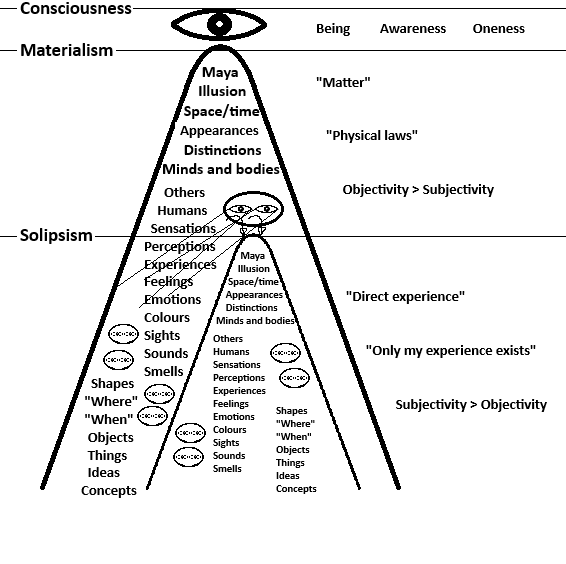
Yeah you flip-flop back and forth. Anyway, enjoy this disaster of a Paint creation. It's called "A lesson in space and time" (each horizontal line represents the ontological primitive of the respective view). The point is that solipsism (and the version that you now have officially endorsed) is Maya:
-
1 hour ago, Eskilon said:Because of people like you Leo deleted his video, it`s too much for such minds.
Leo should've released a video on what space and time (illusion, Maya) is before releasing that video. Because the most unfortunate part is not the people who expressed confusion. It's those who didn't but still took it the wrong way.
Leo actually makes a distinction between "materialist / small self / egoic solipsism" and "Absolute solipsism" (Big Self / cosmic solipsism), but that distinction requires knowing what space and time is or else it doesn't register.
-
17 minutes ago, aurum said:Well I'm not going to speak for those who identify as solipsists.
But if we assume solipsism = One infinite mind (which is you), then there's no problem with space / time. You can easily still have space / time if you are the only Mind that exists.
Yep. The problem is claiming to not make a statement about space and time while actually making a statement about space and time.
-
19 minutes ago, Loveeee said: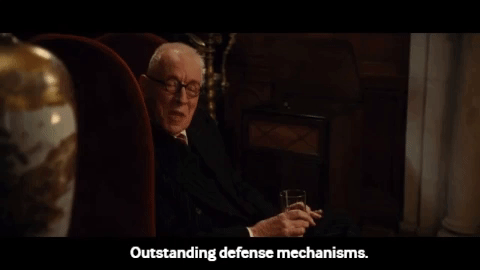
You are stuck in space/time without knowing it.
-
15 minutes ago, aurum said:Any collective you postulate must ultimately be One.
Even in language, we say "a" collective. As in, the collective itself is singular.
You cannot just have a collective of multiplicity.
True. Doesn't change the fact that solipsists are stuck in space/time without knowing it.
-
1 minute ago, Natasha Tori Maru said:There's this weird resistance here to the concept of consciousness as a collective.
It's the individualistic lifestyle championed by the leader, the atomized societal structure of post-modernity, and people being stuck in their minds instead of connecting to people, to nature, to feeling.
-
35 minutes ago, Thought Art said:@Carl-Richard Time and space, are constructs of consciousness?
How so you know anything exists outside your experience though? Because people or resources in your experience tell you? You can’t escape the fact that you believe in things outside your experience but have no proof.
You can only know for sure that you are aware, that you are conscious, that you exist.
But once you accept that, you can grant for sake of pragmatism concepts like appearance, change, time and space to explain what is happening in the illusion, in Maya. And here nothing is for certain, but you can create arguments based on reason, observation, logic, and you can evaluate which arguments seem more convincing.
And then you can create concepts like "other people" and make reasonable arguments that other people have their own private illusory Maya mind-body spatio-temporal experience like you do.
Now, what the solipsists often seem to do is they claim that consciousness is the only thing that exists, but then they inadvertently smuggle in assumptions about appearances, space, time, like "here", "now", "current", "this right here". And then they try to exclude that which is seemingly not "here", "now", "this here", but they of course end up excluding something which belongs to the domain of space/time. And suddenly, they're no longer the most simplest and straightforward perspective that they claim to be but instead a confused and deluded perspective.
-
1 hour ago, Loveeee said:Exactly, but by consciousness you would have to mean this current experience you're having, not some conceptual larger consciousness somewhen somewhere, that's more space/time. Direct experience
And that is solipsism
"Current experience"? "Current" is a construct of time. "This experience right here" is actually a construct of space. So you're again inadvertently referring to constructs of space/time.
If consciousness is beyond space and time, it's not limited to what is current, it's not limited to what is right here. Consciousness is that which knows what is current, what knows what is right here, but it is not limited to it.
You know you are aware, you know you are conscious, you know you are you; that's it. If you want to exclude something happening "somewhere" or "sometime", you are in space and time.
-
4 minutes ago, Loveeee said:Again, I'm asking "where" because you believe in the possibility of other minds and "other" means separation, distance, space
So, where ?
Out of view, just like I can't see the back of my head. But this indeed assumes statements about space/time. If I wanted to not make statements about space/time, I would simply say "consciousness is all there is, end of story" and I would not make statements about whether space/time constructs (other people) have or don't have a certain characteristic.
It's very simple: if you don't believe in space/time, don't make statements about space/time.
-
Just now, Loveeee said:Where other minds
You seem very concerned about space/time ideas for supposedly not believing in space/time.
-
8 minutes ago, Loveeee said:I'm asking "where" because you believe in the possibility of other minds and "other" means separation, distance, space
If you don't believe in "other", then why do you concern yourself with whether other people experience something or not? If you don't want to assume space/time, you should not make statements about things concerning space/time. But solipsists want their cake and eat it too.
-
5 minutes ago, Loveeee said:No you're assuming separation, distance, so where exactly
No, you are 😂 Why are you asking "where?" if you don't believe in space/time?
The problem solipsists have is they grant space/time only when it suits them.
-
9 minutes ago, Loveeee said:Where are other minds ? Are they some kind of bubble separate from your own, floating somewhere ? Where ?
If you are asking "where", you are assuming space/time.
They're out of view.
in Spirituality, Consciousness, Awakening, Mysticism, Meditation, God
Posted
So you're a materialist?